
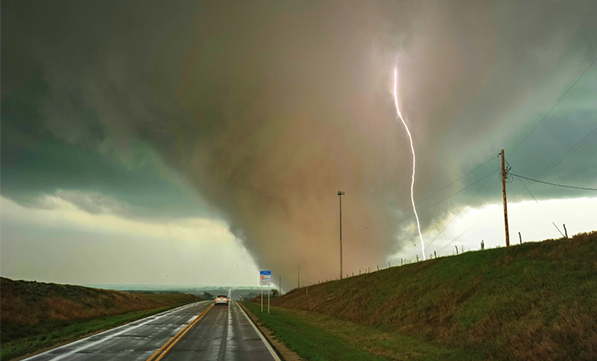

Tornadoes have been observed in many parts of the world. However, they are most frequently found in the United States.
Tornado season has now begun in the United States. More than sixty tornadoes were reported in the south-east of the country during the last weekend in April. One tornado measuring over a kilometre wide hit the state of Mississippi. It destroyed homes, blocked roads, and cut off electricity supplies.
The storms were blamed for ten deaths in Mississippi and two in neighbouring Alabama. Weather experts believe that this was the most intense tornado event since 2008.
A tornado is a violently rotating column of air extending from a thunderstorm cloud to the ground. It extends from a thunderstorm in the sky down to the ground. Its shape is like a funnel: wide at the top and narrower at the bottom.
Tornadoes form when winds blowing in different directions meet in the clouds and begin to spin. Warm air rising from below causes the wind tube to extend towards the ground. Due to their circular movement, these windstorms are also known as twisters.
The most severe tornadoes can reach wind speeds of 320 kilometres per hour or more. In some cases, the resulting damage paths can be more than a kilometre wide and eighty kilometres long.
However, with tornadoes, bigger does not necessarily mean stronger. Large tornadoes can be weak. Some of the smallest tornadoes can be the most destructive. However, no matter their size, tornado winds are the strongest on Earth. Tornadoes have been known to carry homes, cars, and trees from one place to another. They can also destroy anything in their path.
Tornadoes have been observed on every continent except Antarctica. However, experts say they are most commonly seen in the United States. On average, 800 tornadoes are reported nationwide each year.
The National Oceanic and Atmospheric Administration (NOAA) keeps records of tornado sightings. On average, tornadoes kill eighty people and injure one thousand five hundred others nationwide in a year.
Tornadoes are most frequently observed in the central United States, where the land is mostly flat. The area where the most violent tornadoes usually occur is known as ‘Tornado Alley’. It is considered to extend from north-central Texas to North Dakota.
Tornadoes can occur at any time of year. However, most occur from late winter to the middle of summer. In some areas, a second peak occurs in autumn.
These seasons are the result of wind and weather patterns. In spring, for example, warm air moves north and mixes with the cold air left over from winter. In autumn, the opposite happens. Cold air moves south and combines with the remaining warm air from summer.
Tornadoes can strike with little or no warning. Most injuries occur when people are hit by flying objects. Experts say that the safest place to be is in an underground shelter or a small, windowless room on the ground floor of a building.
Drivers are advised to find low ground and lie flat facedown with their hands covering their heads. Those in the path of a tornado often have just minutes to make life-or-death decisions.
The deadliest tornado in American history was the Tri-State Tornado of 18 March 1925. It tore across Missouri, Illinois and Indiana. Around seven hundred people were killed.
A ‘tornado outbreak’ is often defined as six or more tornadoes produced by the same weather system within a day. However, the outbreak of 3rd and 4th April 1974 set a national record. It is remembered as the ‘Super Outbreak’. One hundred and forty-eight tornadoes struck within twenty-four hours. More than three hundred people were killed and nearly six thousand others were injured.
One of the most destructive tornadoes ever recorded hit Xenia, Ohio. The sound you are about to hear was recorded on the website www.xeniatornado.com. It is a recording made by one man of the tornado moving closer.
No two tornadoes look exactly the same. Nor do they act in the same way.
The right combination of wind, temperature, pressure and humidity is needed to create even a weak tornado. Weather experts can identify these conditions. When they observe these conditions, they can advise people that tornadoes might develop. However, they cannot predict exactly where or when a tornado will hit. Tornado warnings still depend largely on human observation.
Communities usually receive a warning at least a few minutes before a tornado strikes. However, there are still some surprises each year when tornadoes develop when they are least expected.
The tornado reporting system involves watches and warnings. A tornado watch means that tornadoes are possible in the area. A tornado warning means that a tornado has been spotted. People are told to take shelter immediately.
However, tornadoes can be difficult to see. Sometimes, the only indication of their presence is the debris they carry through the air. Some night-time tornadoes have been spotted due to nearby lightning strikes. However, tornadoes at night are usually impossible to see.
Tornadoes that form over water are called waterspouts. However, tornadoes cover a much smaller area than hurricanes, which form over oceans.
Tornadoes can be measured using wind speed information from Doppler radar systems. They usually travel in a northeasterly direction at speeds of between thirty-two and sixty-four kilometres per hour. However, they have been reported to move in other directions at speeds of up to 117 kilometres per hour.
In the United States, the strength of a tornado is determined by the damage it causes to buildings. Scientists inspect the damage before estimating the tornado’s severity. They measure tornadoes using the Fujita scale. This system was developed by weather expert Ted Fujita in the 1970s.
There are six levels on the Fujita scale. Tornadoes that cause only light damage are categorised as an F0. Those with the strongest winds, which can destroy well-built homes and throw vehicles over one hundred metres, are categorised as an F5.
Some people make a sport out of watching and following tornadoes. They are known as ‘tornado chasers’ or ‘storm chasers’. Their work can be seen in extreme weather videos, which are becoming increasingly popular on television and the internet.
Some chasers do it just because they enjoy it. Others do it to help document storms and warn the public. Some are even part of weather research teams.
This month, over one hundred researchers began deploying radar and other scientific instruments across America’s Great Plains. In the second and final year of an international project known as VORTEX2, they hope to surround tornadoes. The project’s goal is to examine in detail how tornadoes form and the damage they cause.
Last year, the project collected information about a tornado in south-eastern Wyoming. Researchers also observed several other powerful storms that were not tornadoes.
According to the National Weather Service, the United States experiences more severe weather than any other country. For one thing, it is much larger than most other countries. It also has a variety of conditions that create many different types of weather.
There are coastlines and deserts, flatlands and mountains. The West Coast is located alongside the relatively calm Pacific Ocean. In contrast, the East Coast is along the Atlantic Ocean, which is known for its hurricanes. These mainly affect the south-eastern states.