

Scientists who study the Earth tell us that the continents and the ocean floors are constantly in motion. This movement can sometimes be violent, causing death and destruction. Today, we examine what causes earthquakes and volcanic activity.
The first images of Earth taken from space revealed a solid sphere covered in brown and green landmasses surrounded by blue-green oceans. It seemed as though the Earth had always looked this way and always would.
However, the Earth’s surface is not as solid or permanent as previously thought. Scientists have discovered that the Earth’s surface is constantly in motion. Continents move around the planet like huge ships at sea, floating on pieces of its outer skin, or crust. New crust is formed when melted rock pushes up from inside the planet. Old crust is destroyed as it moves towards the hot rock and melts.
During the 20th century, scientists began to understand that the Earth is a vast, living — and moving — structure. Some experts say that this realisation represents one of the most significant developments in the history of science.
Our knowledge of the Earth’s constant motion is based on the work of scientists who study the movement of the continents. This process is called plate tectonics.
Earthquakes and volcanic activity result from this process. Plate tectonics is the scientific discipline that explains why the Earth’s surface moves and how these movements cause earthquakes and volcanic activity.
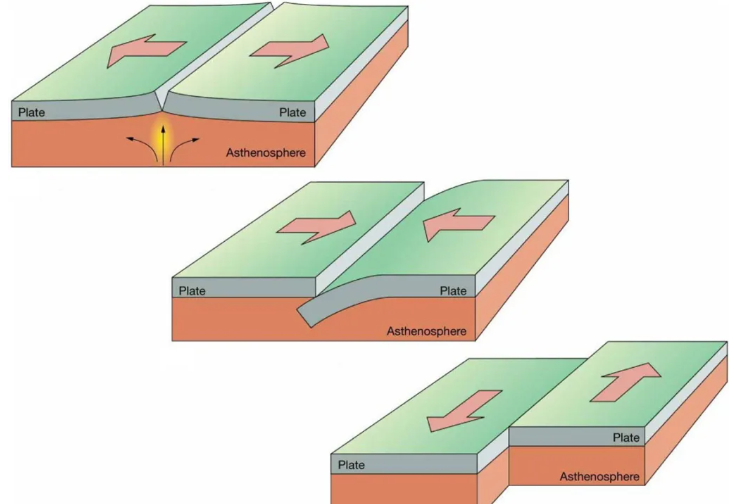
Scientists say that the Earth’s surface is cracked like a huge eggshell. They call these pieces ‘tectonic plates’. There are as many as twenty of them covering the Earth. Sometimes the plates hit each other and sometimes they move away from each other. Since some continents sit above two plates, they move when the plates move.
The movement of tectonic plates can cause earthquakes and volcanoes. Modern instruments show that around ninety percent of all earthquakes occur along a few lines in various locations around the Earth. These lines follow underwater mountains where hot liquid rock flows up from deep within the Earth’s interior. Sometimes, the molten rock erupts with great force. This can force pieces of the Earth’s surface apart in a violent earthquake.
Some earthquakes occur at the edges of continents. Pressure builds up as two plates move against each other. When this happens, one plate suddenly moves past the other, causing the Earth’s surface to split open.
An example of this can be found on the west coast of the United States. One part of California sits on the Pacific Plate. The other part of the state sits on the North American plate.
According to scientists, the Pacific plate is moving towards the northwest, while the North American plate is moving towards the southeast. These two huge plates meet at a fault line. The line between these two plates in California is known as the San Andreas Fault. Most of California’s earthquakes occur along or near this fault line, as the two tectonic plates move in different directions.
The city of Los Angeles is located approximately fifty kilometres from the San Andreas Fault. Many smaller fault lines can be found throughout the Los Angeles area. A major earthquake in 1994 happened along one of these smaller fault lines.
As mentioned earlier, scientists began making significant discoveries about plate tectonics in the 20th century. One of these scientists was Alfred Wegener from Germany. One hundred years ago, he proposed that the continents had moved and were still moving.
Wegener said that he came up with the idea when he noticed how the coastlines of South America and Africa fit together like two pieces of a jigsaw puzzle. He suspected that the two continents might once have been joined, before splitting apart.
He believed that the continents had once been part of a vast landmass that he named Pangaea. He said this huge continent had split up more than two hundred million years ago. He also said that the pieces were still drifting apart.
Alfred Wegener investigated the idea of continental drift. He noted that a line of mountains stretching from east to west in South Africa resembled a line of mountains in Argentina, located on the opposite side of the Atlantic Ocean. He also found fossil remains of the same species of early plant in parts of Africa, South America, India, Australia, and even Antarctica.
He said that these mountains and fossils were evidence that all the land on Earth had once been united.
He also noted differences between the continents and the ocean floor. He said that the oceans were more than just low-lying areas that had filled with water. Even if the water was removed, he said, differences would still be visible between the continents and the ocean floor.
Furthermore, the continents and the ocean floor are not made of the same kind of rock. The continents are made of granite-like rock. Granite forms when hot, liquid rock cools and hardens beneath the Earth’s surface. In contrast, the ocean floor is made of basalt, a mixture of silicon and magnesium. According to the German scientist, the lighter continental rock floated up through the heavier basalt rock of the ocean floor.
Support for Alfred Wegener’s ideas did not emerge until the early 1950s. Two American scientists discovered that the continents were moving as new seafloor was formed beneath the Atlantic Ocean. Harry Hess and Robert Dietz identified a narrow valley in the Atlantic as a location where the ocean floor splits. They theorised that hot, melted material flows up from deep inside the Earth through the split. As this material reaches the ocean floor, it spreads out and cools, eventually hardening to form new ocean floor. This becomes new ocean floor.
The two scientists proposed that the Atlantic Ocean floor is moving away from both sides of the split. This movement is very slow — just a few centimetres a year. Eventually, they said, the moving ocean floor will be blocked when it comes up against the edge of a continent. It is then forced down under the continent and deep into the Earth, where it melts again.
Harry Hess and Robert Dietz said that this process does not make the Earth bigger. As new ocean floor is created, an equal amount is destroyed.
The two scientists confirmed that Alfred Wegener was correct. The continents move as new material from the centre of the Earth rises, hardens, and pushes older pieces of the Earth’s crust away from each other. Continents are in constant motion, although we cannot feel it.
They named their theory ‘sea floor spreading’. This theory explains how the tectonic plates are pushed and pulled in different directions as the sea floor spreads.
Diamonds formed deep within the Earth have helped scientists to determine when the continents first began to move. A report on these diamonds was published in the journal Science last July.
American and South African researchers studied over four thousand four hundred diamonds from five continents. They say that mineral grains trapped inside the diamonds provided information about the Earth’s mantle. Changes in the chemical structure of these grains suggest that plate tectonics began between three and 3.2 billion years ago.
The theory of plate tectonics can be used to explain both volcanoes and earthquakes. Many of the world’s volcanoes are located at the boundaries of tectonic plates, where geological activity is intense. The high concentration of volcanoes around the Pacific Plate has led to this region being known as the ‘Ring of Fire’.
However, volcanoes are also found in the middle of plates, where there is a reservoir of molten rock. Scientists call these wells ‘hot spots’. Hot spots do not move. However, as the tectonic plate moves over it, a line of volcanoes forms.
The Hawaiian Islands were formed in the middle of the Pacific Ocean when the tectonic plate slowly moved over a hot spot. This process continues as the plate moves.
Volcanoes and earthquakes are among the most frightening natural phenomena. They remind us that the Earth is not as solid or unchanging as we would like it to be.