
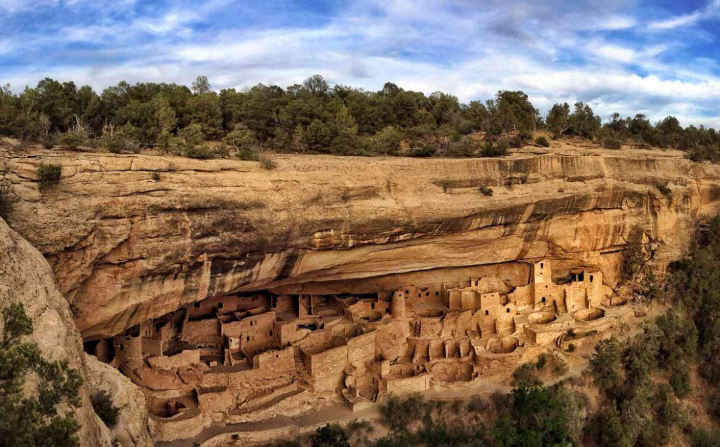

Today, we will be talking about a large national park that was established to protect the culture of the ancient Native Americans. It is called Mesa Verde.
It was a cold day in southwestern Colorado in 1888. Richard Wetherill and his brother-in-law were trying to find some missing cattle. They were up on Mesa Verde. The area had been named by Spanish explorers. The high, flat mountaintop is covered in green junipers and pine trees. It looks like a huge green table, which is ‘mesa verde’ in Spanish.
The two men came to the edge of a deep canyon. Despite the falling snow, they could see what looked like a small city across the canyon. It was suspended in the middle of the rock wall. There were many interconnected rooms built into a natural rock formation.
They named these ruins Cliff Palace. Over the next few days, they discovered two more large ruins. They named one Spruce Tree House. The other was named Square Tower House.
Some of the cliff dwellings had been seen and photographed by other people earlier. However, the Wetherill family were the first group to study them. Soon after making his discovery, Richard Wetherill returned to Mesa Verde and the ruins that had remained silent and untouched for centuries.
He collected many objects. It was an easy task. It seemed as though the people who had lived there had simply walked away, leaving everything they owned behind: Cooking pots by the fireplaces. Food bowls were scattered across the floors. Shoes in the corners. Sticks for digging were by the doors.
These ruins in Colorado had once been home to the ancestors of the Pueblo tribes. The Navajo Indians named them the Anasazi, meaning ‘ancient ones’. They moved to Mesa Verde around 1,500 years ago and left around 700 years ago. Towards the end of their eight hundred years there, they built the cliff dwellings in Mesa Verde.
Richard Wetherill displayed his collection of artefacts in nearby towns. People were not interested. ‘Just some more old Indian things,’ they said. Eventually, he sold his collection to the Colorado Historical Society. However, the Wetherill family continued to explore Mesa Verde. Their discoveries gained recognition in the eastern United States and Europe. Hundreds of people went to Mesa Verde to see the finds for themselves.
One of the earliest visitors was a young man from Sweden named Gustaf Nordenskiold. Mr Nordenskiold spent months exploring the area. He travelled on foot and on horseback. He took photographs which were published in a book entitled The Cliff Dwellers of the Mesa Verde.
He collected hundreds of objects that he found in the ruins. He loaded them onto teams of mules and sent them to the nearby town of Durango in Colorado. Local officials tried to stop him removing so many artefacts. However, there were no laws to stop him. Mr Nordenskiold shipped the artefacts to Sweden. They were later given to the National Museum in Helsinki, Finland, where they remain today.
Many people were shocked by the ongoing removal of artefacts from the Mesa Verde ruins. One such person was a woman named Virginia McClurg. She had visited the area and explored a few small ruins. From 1887 to 1896, she campaigned throughout the country for laws to protect the cliff dwellings. She gave speeches describing how the dwellings were being destroyed by people seeking treasures. She spent years working with members of the United States Congress to get such laws passed.
Finally, on 29 June 1906, President Theodore Roosevelt signed a bill to create Mesa Verde National Park. This was the first national park designed to protect human creations. Congress then approved the Federal Antiquities Act of 1906. This Act helps to protect ancient ruins on federal lands.
From a distance, Mesa Verde appears today as it did centuries ago. It rises over 540 metres above the valley floor. Visitors can drive up to the top on a winding mountain road. Once there, they are two thousand four hundred metres above sea level. In the distance, you can see the plains and mountains of the Four Corners area. This is where the US states of Colorado, New Mexico, Utah and Arizona meet. This area has one of the largest concentrations of archaeological sites in the United States.
Within the national park, there are more than 5,000 ruins dating back to the time of the Ancestral Puebloan people. Six hundred of these are cliff dwellings. Most of the ruins remain unexplored. Some have been excavated and stabilised to make them safe to visit. These sites are open to the public for most of the year. During the winter, activities are limited. The visitor centre at the park is open in the summer. The museum is open all year.
Both the visitors’ centre and the museum provide information about the history and culture of the ancient Pueblo people, as well as that of present-day Indians. National Park Service guides lead visitors to the ruins. They give talks about the area’s cultural history. They also talk about the area’s geology and wildlife.
Some of the ruins in the Four Corners area date back to the earliest inhabitants of the region. These people were hunters and gatherers, known today as the Basketmakers. The Basket Makers lived in simple caves. Their civilisation existed two thousand years ago. The first evidence that ancient people had moved to Mesa Verde dates back to around the year 500. These people lived in pit houses. These were large holes in the ground with wooden and mud roofs.
Around the year 750, the early Pueblo people began constructing above-ground structures comprising large connected rooms, known as pueblos. Around eleven hundred years ago, they started building cliff dwellings after climbing down the canyon walls. Today, visitors to Mesa Verde can see the remains of all four types of settlement.
Cliff Palace is the largest cliff dwelling in Mesa Verde and in North America. It has 150 rooms. It is difficult to access. Visitors must climb down into the canyon via a narrow path with many steps. They must also climb down several ladders. However, the trip is well worth the effort. Visitors can explore a magnificent stone and clay structure.
Spruce Tree House is the third largest cliff dwelling in Mesa Verde National Park. It has 114 rooms. It also has eight underground rooms known as kivas. The Indian men would gather in these for special ceremonies. Around one hundred people lived in this cliff dwelling during the thirteenth century.
Spruce Tree House is the easiest cliff dwelling to visit. The path winds down into the valley and then back up to the ruins. There are signs along the path pointing out trees and plants that were used by the Ancestral Puebloan people. The juniper and pinon pine trees that line the path also make Mesa Verde green.
Around half a million people visit Mesa Verde National Park each year. The park’s archaeologists have recovered many artefacts used by the ancient Pueblo people, including pots, tools, and jewellery. Many of these artefacts are displayed in the visitor centre. However, human remains or any object from a grave may not be touched or displayed. This is to honour the wishes of the modern Puebloan people who live in the area today.
Mesa Verde National Park covers twenty-one thousand hectares of land. However, only around ten percent of the area has been explored.
Mesa Verde is recognised as a special place. In 1978, the United Nations named it one of the first World Heritage Sites. Special events were held at Mesa Verde to celebrate its one hundredth anniversary in 2006. These included tours of areas that had never before been open to the public.
The Pueblo Indians, whose ancestors lived in Mesa Verde, consider it a sacred place today. For visitors from around the world, it remains a place of mystery and beauty.