

Since ancient times, cultures around the world have made and performed with puppets. These puppets express the ideas and beliefs of human societies through stories. Puppets are inanimate objects that, when controlled correctly, appear to come to life. The puppeteer’s role is to bring these forms to life.
Join us as we explore the world of puppetry and visit an organisation in Atlanta, Georgia, which supports this unique art form.
The tradition of bunraku puppetry in Japan dates back hundreds of years. Bunraku puppets are quite large. Unlike most puppets, it requires three puppeteers to operate. One puppeteer controls the doll’s head, face and right hand. Another controls the left hand. The third operates its legs and feet. The puppeteers train for many years to work together seamlessly, bringing the puppet to life to perform in complex theatre productions.
The Karagoz shadow puppet tradition began in Turkey around the seventeenth century. These Turkish shadow puppets are flat. They are made of very thin pieces of leather that have been painted in bright colours. In shadow puppet theatre, the puppeteer stands behind a white cloth screen and holds the semi-transparent puppets against it. Light from behind the screen illuminates the colourful puppets for the audience on the other side to see.
The Punch and Judy tradition of puppet shows has its roots in sixteenth-century Italian Commedia dell’Arte theatre. Punch and Judy shows later became very popular in Britain. Many other countries have their own versions of Punch and Judy puppets. In France, the equivalent to Punch is Polichinelle, and in Russia, he is known as Petrushka.
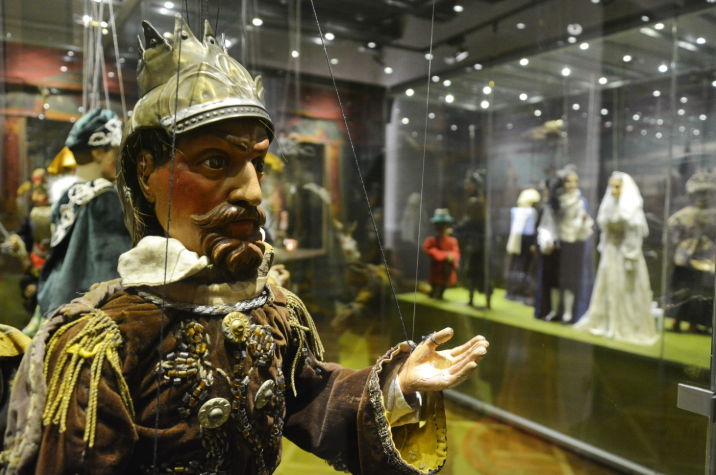
In addition to shadow puppets, there are three main types of puppet. Rod puppets are controlled by sticks or wires attached to their main body parts. As the name suggests, hand puppets are worn on and controlled by the puppeteer’s hand. Marionettes are controlled from above by a series of strings or wires.
Before the advent of television and the internet, puppet shows were a popular form of entertainment for people of all ages around the world. What kind of puppet traditions exist where you live?
To learn more about puppet traditions, visit the Center for Puppetry Arts in Atlanta, Georgia. The centre’s museum is filled with over one thousand five hundred puppets from around the world. They illustrate the rich history of this art form.
Jeremy Underwood is the museum’s curator. He can recount the story of each puppet, including a finely carved Mexican marionette.
Jeremy Underwood says, “This is actually a really cool piece. It was made by the Rosete-Aranda Company. They were active in the 1920s and 1930s. They started out with biblical stories, but then branched out to different folk stories. This one’s a cowboy. They were actually influenced by Italian puppetry, which is very realistic. So not all puppets are made of foam and fleece. They are very intricately carved pieces of art.”
Mr Underwood says that Asia has a very rich puppetry tradition. He mentions that around eight hundred of the puppets in the Center for Puppetry Arts’ collection originate from Asia.
Jeremy Underwood continues, “In this case, we have Wayang Golek and Wayang Klitik, which are two major forms of traditional Indonesian puppetry. Behind you, we have Wayang Kulit, which is Indonesia’s shadow puppetry. These are the three major forms of puppetry in Indonesia. We also have Chinese and Indian puppets.’
Of course, not all of the puppets at the Center for Puppetry Arts date back to ancient times. Many are very recent, including a collection created by the renowned American puppeteer Jim Henson. Henson created puppets for several television series and films, including Fraggle Rock, The Muppets and Sesame Street. His shows were extremely popular because they were funny yet educational. You can see several of his characters, including Big Bird and the Swedish Chef.
One large puppet called Trashcan Phoenix was designed by the artist Michael Curry. Curry has designed productions for performance groups including Cirque du Soleil, the Metropolitan Opera in New York City, and Disney Theatrical Productions.
At the press of a button, the trashcan-like form unfolds and spreads its wings to become a bird. This mechanical bird demonstrates how modern technology is expanding the possibilities of puppetry.
The Center for Puppetry Arts offers much more than just a museum. It is also a centre for puppet performances. Vincent Anthony founded the organisation in 1978. Since then, the group has been planning and performing all kinds of puppet shows.
Vincent Anthony says, “It’s interesting to see the performance context. What kind of performances do they have in India and China nowadays? We invite groups from all over the world to come here. Then we ask ourselves, what kind of performances can we create that are contemporary and speak to a whole new audience?”
Some of the puppet shows at the Center for Puppetry Arts are aimed at young people. For instance, “Adventures of Little Noodle” is about a pasta-based character who explores the food store where she lives with her family.
The play aims to educate young people about making healthy choices regarding food and exercise. The show is performed by three puppeteers dressed in black.
Using special lighting effects, the puppeteers became invisible and their brightly coloured puppets took over the stage. At the end, the puppeteers talked about the importance of eating healthy foods such as fruit and vegetables. They also explained to the watching children how they operated the puppets.
After the show, children could attend a workshop and learn how to make a paper version of the Little Noodle puppet.
The centre’s next children’s show is called Dinosaurs. It’s about a bird named Francine who travels back in time to learn about her ancient relatives, the dinosaurs. We watched the puppeteers practising for this new show.
Singing and acting while controlling the expressions and movements of the puppet requires great skill.
Not all of the centre’s shows are for children. Next month, to mark the Halloween season, the centre will begin its ‘Ghastly Dreadfuls’ show. This winter, the show ‘Tales of Edgar Allan Poe’ will bring the stories of this famous American writer to life in puppet form.
The puppets for these shows are made in a workshop that forms part of the centre. Jason von Hinezmeyer is the organisation’s lead puppet builder. He collaborates with Artistic Director Jon Ludwig to bring these performances to life.
The Center for Puppetry Arts also invites other puppet groups to perform on its stages. These include Tanglewood Marionettes, based in Ware, Massachusetts, and Nappy’s Puppets, based in North Haven, Connecticut. La Pendue is a French puppet group that performs its own version of the Polichinelle tradition. Gray Seal Puppets, based in Charlotte, North Carolina, travel around the United States. They perform in schools, libraries, and at festivals. One of their puppet plays is called Bathtub Pirates.
Blackbeard: ‘Perfect! Well done, Mister Tweezers, well done.’
TWEEZERS: ‘Aye, aye, Captain.’
Blackbeard: ‘Yes, I believe the tub will suit our needs perfectly, Tweezers, perfectly!’
Educational programmes form another important part of the Centre for Puppetry Arts. Adults can enrol on courses to learn how to build and operate puppets.
The centre’s distance learning programme uses puppets to teach children in classrooms across forty-four American states. Using video technology, educators and performers at the centre in Atlanta, Georgia, can connect with classrooms across the country.
The programme uses puppets to educate students on subjects such as dinosaurs, plants, and the rainforest. Other programmes cover American and European literature, as well as puppet traditions around the world.
These efforts are helping to introduce a whole new generation to the magical world of puppetry.