
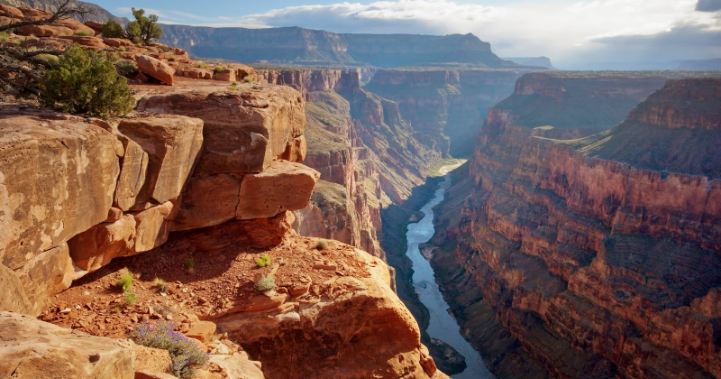

Today, we are taking you to one of the most popular and beautiful places in the United States. The Grand Canyon, located in the southwestern state of Arizona.
The canyons of the American Southwest are deep, ancient chasms in the earth’s surface. They appear to have formed when the earth split apart. But the canyons did not split open. They were carved by rivers. Over millions of years, the rivers carried dirt and pieces of stone that slowly eroded the surrounding rock. For millions of years, the rivers turned and pushed. They cut deeper and deeper into the earth. They left behind vast, rocky openings that extend for hundreds of kilometres.
The Grand Canyon in Arizona is one of the largest and most beautiful canyons in the world. It extends 450 kilometres.
The surrounding area does not suggest the existence of such a vast opening in the earth. You suddenly come upon the canyon when you reach its edge. Then you find yourself looking at a landscape unlike anything else in the world.
Walls of rock fall away sharply at your feet. In some places, the canyon walls are over a kilometre deep. Far below, the dark, winding line of the Colorado River can be seen.
On the other side, the sunlight illuminates the bare rock walls in shades of red, orange and gold. These bright colours are the result of minerals in the rocks. Their appearance changes endlessly with the light, time of year and weather. At sunset, as the sun moves across the sky, the canyon walls lose their fiery reds and golds. Instead, they take on quieter colours of blue, purple and green.
Hundreds of rocky points rise from the bottom of the Grand Canyon. Some are very tall. Yet they are all below the level of an observer standing on the edge and looking down.
Looking at the Grand Canyon is like taking a step back in time. Around forty million years ago, the Colorado River started to cut through the area. At the same time, forces deep within the Earth pushed up the surrounding land. Over time, rain, snow, ice, wind and plant roots eroded the top of the new canyon. Meanwhile, below, the flowing river continued to uncover more and more levels of ancient rock.
Some of the oldest rocks on Earth can be seen here. There are many layers of granite, schist, limestone and sandstone.
The Grand Canyon experiences a variety of weather conditions. Conditions at the top are often very different to those at the bottom. On some winter days, for instance, you may encounter cold winds and snow at the top. But at the bottom, you may find warm winds and flowers.
The canyon is home to several species of plants and animals that are found nowhere else on Earth. Because the environments within the canyon are so different, these species have not spread beyond it, or even far within it.
The Grand Canyon was occupied by Native American Indians three thousand years ago. Evidence of their existence has so far been found in more than two thousand five hundred places. Bones, hair, feathers and even plant remains have been found in deep, dry caves high up in the rock walls.
The Hopi, the Paiute and the Navajo, among other Native American tribes, have inhabited the area for at least seven centuries. However, much of what we know today about the Grand Canyon was recorded by John Wesley Powell. In 1869, he became the first white American to explore much of the canyon.
He and his group travelled in four boats. They knew very little about navigating the rapid, rocky waters of the Colorado River. In many areas of fast-flowing water, a wave as high as a house could turn over a boat.
Shortly after setting off, Powell’s group lost some of their food and equipment. Then three members of the group left. As they walked out of the canyon, they were killed by Native Americans. The rest of the group was fortunate to survive. Starving and exhausted, they finally reached the end of the canyon. They had travelled on the Colorado River for more than three months. John Wesley Powell’s reports and maps from the expedition made him famous. They also greatly increased interest in the Grand Canyon. However, visitors did not begin to flock there in large numbers until 1901. This was when a railway reached the area.
Today, the Grand Canyon is recognised as one of the seven wonders of the natural world. Around five million people visit the canyon each year. Most visitors walk along paths partway down into the canyon. It takes several hours to walk to the bottom. It takes twice as long to climb back up again. Some visitors ride mules to the bottom and back. These strong animals look like horses. They are known for their ability to walk slowly and safely along the paths.
America’s National Park Service is responsible for protecting the Grand Canyon from the effects of its many visitors. All waste material must be carried out of the canyon. All rocks, historical artefacts, plants and wildlife must be left untouched. As the National Park Service tells visitors: ‘Take only photographs. Leave only footprints.” ‘
There are several other ways to experience the Grand Canyon. Hundreds of thousands of people see the canyon by air each year. They pay a pilot to fly them in a helicopter or aeroplane above and around the canyon.
Around 20,000 people a year see the Grand Canyon from the Colorado River itself. They travel by boat over the fast-flowing, rocky water. These trips last from one to three weeks.
Visitors can experience the Grand Canyon in a whole new way. The Skywalk is a huge glass walkway extending twenty-one metres from the edge of the canyon. Suspended more than 1,200 metres above the bottom of the canyon, the Skywalk is shaped like a giant horseshoe. It is shaped like a giant horseshoe. For a fee of twenty-five dollars, visitors can walk beyond the canyon walls and stand at the edge of the glass bridge, surrounded by the canyon.
The Hualapai Indian Tribe built the Skywalk at a cost of over forty million dollars. The tribe owns almost 400,000 hectares of land in the canyon. The Skywalk was built to attract more visitors to the reservation and generate income for the tribe. According to the tribe, the area, known as Grand Canyon West, will eventually feature a large visitor centre, restaurants and potentially hotels.
Some people regard the Skywalk as an engineering marvel. However, others have criticised the Skywalk and future development plans. They argue that it damages a national treasure and diminishes the experience of enjoying nature in the Grand Canyon.
Many writers have tried to describe the wonder of the Grand Canyon. They use words such as ‘mysterious’, ‘overpowering’ and ‘strange’. Yet they recognise that it is impossible to attribute human meaning to such a place. The Grand Canyon exists in its own space and time.
Some visitors say they feel small in comparison to the canyon’s vastness. One writer who has spent a lot of time there finds it a peaceful place. He says that the almost overwhelming silence and vastness of the Grand Canyon briefly shakes people out of their sense of self-importance. It makes us remember our place in the natural world.