
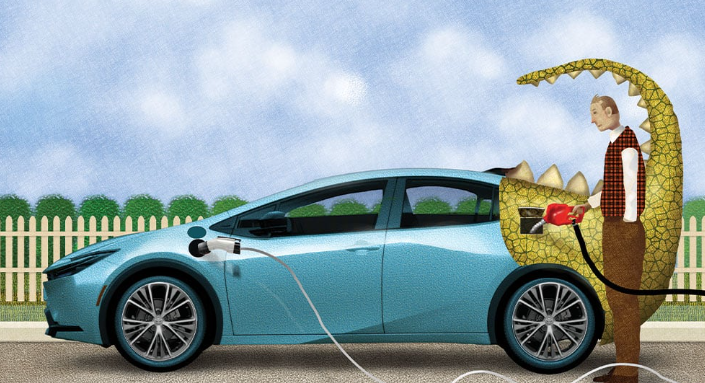

The auto industry will showcase more than 900 of its latest vehicles at the LA Auto Show in Los Angeles, California. The event will showcase around fifty hybrid, electric and alternative fuel cars that could soon be available in the United States.
Join us as we explore these new types of cars and their implications for the future of driving in America.
At the beginning of the 20th century, the automobile was a rare sight. Many early models ran on electric batteries. However, it was not until Henry Ford’s petrol-powered Model T that the internal combustion engine and the car became inseparable.
Henry Ford had wanted to develop an electric car. However, the technology of the time was not advanced enough. Today, the same problems that early automobile pioneers faced remain. However, there are materials available to overcome these problems. The result is that electric batteries and motors may finally power the cars of the future. Some experts predict that five to ten percent of cars on the road in 2020 will be electric.
The heart of any electric car is its battery. A battery stores electricity and makes it available for use by the motor. Hybrid vehicles, which run on both electric power and gasoline, are already common in many countries, including the United States and Japan.
Hybrid vehicles run on both electric power and gasoline. The Toyota Prius is currently the best-selling hybrid car on the American market. Most current hybrid cars use an internal combustion engine to drive the car and help provide electric power stored in a battery. The battery then uses this stored energy to power the car at low speeds.
The race to develop electric cars and other fuel-efficient models gained urgency earlier this year. The Obama administration introduced new regulations in the United States. These require 2016 model vehicles to achieve an average of 15 kilometres per litre of gasoline.
The race to develop electric cars and other fuel-efficient models became more urgent earlier this year. The Obama administration introduced new regulations in the United States. These require 2016 model vehicles to achieve an average of 15 kilometres per litre of gasoline.
One way to improve average fuel economy is to increase the number of electric cars on the road. Manufacturers are therefore rushing to bring electric vehicles and hybrids to market. Many models will be on display at this year’s LA Auto Show.
No car in recent years has been as important to a manufacturer as the Chevy Volt is to General Motors. This electric hybrid car is set to be released next year.
GM plans to float on the stock market soon, potentially raising up to seventeen billion dollars. GM has reported profits of over four billion dollars this year. The company suffered huge losses during the economic crisis of 2008–2009. The Volt could change all that. Its release could signal that GM has recovered from the bankruptcy and restructuring it underwent last year.
GM began taking orders for the Volt in July. General Electric has promised to purchase 25,000 electric vehicles. This includes 1,000 Chevy Volts next year, with more to follow.
The Volt is designed to run as an electric car for over sixty kilometres. After that, a petrol engine powers the car. The battery and gas generator enable the Volt to travel a total of approximately 560 kilometres on a single charge and tank of gasoline.
What sets the Volt apart is that its electric motor always powers the car. Petrol is only used to generate electricity. GM engineers say they chose this design because it is ten to fifteen per cent more efficient. They also used a new lithium-ion battery which is expected to last longer than the batteries in current hybrid cars.
GM is selling the Volt for around forty-one thousand dollars. This is more than twice the cost of other small GM cars. However, buyers can receive a tax credit of seven thousand five hundred dollars from the government for purchasing a Volt.
In the past, fuel-efficient cars have tended to be small cars, which Americans have tended to reject — at least when petrol prices are low. High school and college students represent a significant market for such vehicles. However, a change has taken place in the world of environmentally friendly cars. Several of them are sports cars.
Tesla is a new car manufacturer based in Palo Alto, California. The company’s chief executive is Elon Musk. He is also the driving force behind SpaceX, a space travel company. Tesla’s goal is to make all-electric cars more affordable. However, the Tesla Roadster has attracted a lot of attention as a fast sports car costing over one hundred thousand dollars.
Tesla cars were first offered for sale in 2008. According to the company, there are now 1,300 Roadsters being driven around the world.
The Roadster can reach speeds of up to approximately 200 kilometres per hour. It also releases zero pollution. Depending on how fast it is driven, it can travel almost four hundred kilometres before it needs recharging.
Fisker Automotive is a new car manufacturer based in Irvine, California. Its expensive sports car is called the Karma. Like the Chevy Volt, the Karma initially runs on electricity. Then it uses petrol to power an electric motor. It also has solar panels on the roof. According to the company, the panels collect enough energy to extend the battery charge. Fisker claims that the Karma can travel approximately twenty-nine kilometres on a litre of petrol and a full electric charge.
Not all new, fuel-efficient cars are electric or hybrid. Diesel engines have long been used in long-distance trucks and buses. Diesel fuel is denser than gasoline. It produces more energy when it burns. However, high levels of sulphur in diesel made from petroleum meant that diesel engines produced a strong smell. However, newer, more refined diesel solves this problem.
Don Hillebrand is the Director of Transportation Research at the US Department of Energy’s Argonne National Laboratory near Chicago, Illinois. His team of engineers works on new diesel technology. He says that, until recently, American car manufacturers did not offer many diesel cars in the United States.
DON HILLEBRAND: ‘Many American companies make excellent diesel engines, but they only sell them overseas. They don’t actually sell them in North America.’
Mr Hillebrand also says that diesel can help to reduce the use of carbon-based fuels.
‘Diesel can give you an extra thirty percent fuel economy, which equates to a substantial amount of carbon reduction and cost savings.’
The Ford Motor Company manufactures diesel vehicles for the European market and could sell them in the United States. GM has also announced plans to manufacture a diesel passenger vehicle for the American market.
Nevertheless, gasoline engines remain the most common type of engine in passenger vehicles in the United States and are expected to remain so. Some manufacturers are developing cars with new levels of fuel efficiency.
GM is offering the Chevrolet Cruze Eco. It has a petrol engine that is more fuel-efficient than most hybrid models. The car can travel approximately seventeen kilometres on a litre of petrol.
Then there is the issue of extreme fuel efficiency. The Edison2 is an experimental car that won the ten-million-dollar Progressive Insurance Automotive X Prize. The prize was awarded to teams that could design a vehicle capable of travelling at least one hundred miles on one gallon of gas. That equates to at least forty-three kilometres per litre.
Oliver Kuttner led the Edison2 team. He claims that electric cars have a weight problem. He claims that their batteries are too heavy. He believes that very lightweight cars are more efficient than electric cars could ever be. The Edison2 car uses E85 fuel, which is mostly ethanol — a type of alcohol.
However, affordable all-electric cars are no longer something for the distant future. Japanese carmaker Nissan has announced that it will start selling its LEAF next month.
The LEAF has no petrol engine. It runs entirely on stored electric power. The company has not released exact performance details. However, Nissan says the LEAF will travel about 160 kilometres between charges. Nissan claims that 95% of drivers travel fewer than 160 kilometres a day.
The LEAF is one of five cars competing for the 2011 Green Car of the Year award, alongside the Chevy Volt. The other finalists are the Ford Fiesta, the Hyundai Sonata Hybrid, and the Lincoln MKZ Hybrid. The prize is awarded by Green Car Magazine, which has been writing about cars, energy, and the environment for eighteen years. The winner will be announced at the LA Auto Show on Friday.