
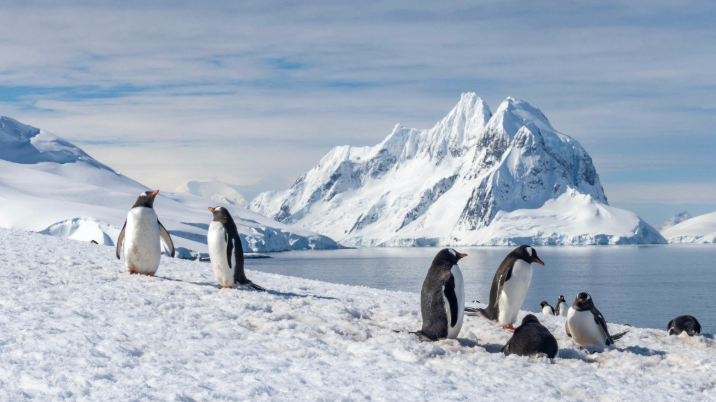

Today, we are travelling south to Antarctica, one of the coldest, windiest and least populated places in the world. The word ‘Antarctica’ comes from a Greek root meaning ‘opposite to the north’.
This vast continent, located at the South Pole, covers an area of approximately fourteen million square kilometres. Around ninety-eight per cent of this area is covered in ice. Join us as we explore the history of Antarctica, as well as its environmental and scientific importance.
Every year, scientists from over twenty-seven countries conduct research in this unique environment. These scientists come from many different fields of study. These include biologists, astronomers, physicists, and geologists. Exciting discoveries are always being made in this huge natural laboratory.
For instance, a group of small organisms that appear to have lived under the ice for millions of years was recently discovered by scientists. The water beneath the ice is highly saline and contains various minerals, including iron. These bacteria use the minerals to survive. Jill Mikucki led the team of scientists who explored an area under an ice formation known as the Taylor Glacier.
“We have a lot to learn from the microbes that survive in these kinds of environments and have adapted to these cold, low-energy systems,” says Jill Mikucki. They’re very efficient.’
Not far from Taylor Glacier, researchers from NASA are using the icy Lake Bonney to test an underwater robot vehicle. This vehicle is enabling scientists to explore huge areas underneath the lake that would otherwise be impossible to reach. Developing this kind of vehicle could be useful for future space operations. Scientists hope that one day it will permit them to explore the icy oceans on Jupiter’s moon Europa.
One of the most important subjects studied in Antarctica is climate change. They say that the thinning ozone layer over the South Pole causes climate change to occur more quickly there than in other areas of the world.
Yves Frenot is the deputy director of the French Polar Institute. He says that scientists estimate climate change has caused temperatures in the Antarctic Peninsula to increase by two or three degrees Celsius over the past fifty years. He says this is a huge increase compared to previous changes.
Signs of climate change include increased rainfall, new plant life and melting ice sheets. Melting ice resulting from climate change would affect coastal areas around the world. However, scientists disagree about how much sea levels could rise if Antarctica’s ice sheets continue to melt.
Last month, one group of researchers published their findings in Science magazine. Jonathan Bamber of the University of Bristol’s Glaciology Centre led the study. The team predicted that sea levels would rise by around three metres. This is three metres less than in other studies. Most scientists agree that climate change is a serious problem requiring the attention of people and governments worldwide.
There is no official agreement about who discovered Antarctica. Since ancient times, thinkers including the Greek astronomer Ptolemy have believed in the existence of a huge continent at the South Pole. They named this mysterious continent: Terra Australis Incognita, meaning “Unknown Southern Land”.
In the 1770s, the English explorer James Cook set out to find this undiscovered continent. However, he was searching for a much larger continent. On his third voyage, he and his crew sailed around Antarctica. His boat crossed the Antarctic Circle in three places, yet he still failed to sight land. At the time, this was the southernmost point ever reached.
At around the year 1820, crew members on three different ships claimed to have sighted Antarctica. These were American sailor Nathaniel Palmer, Russian captain Fabian Bellingshausen, and British captain Edward Bransfield. The race by countries to explore Antarctica had begun.
Examining a modern-day map of Antarctica provides insight into its earliest explorers. In 1839, the American naval officer Charles Wilkes led an expedition to the continent. He mapped over two thousand kilometres of the continent’s coastline. His efforts helped to prove that Antarctica was indeed a continent. The area known as Wilkes Land is named after him.
In 1841, the British naval officer James Ross discovered the Ross Sea and Ross Ice Shelf. Other famous 20^(th)-century explorers of Antarctica included Ernest Shackleton, Roald Amundsen and Richard Evelyn Byrd.
It may seem surprising that such a cold continent with no native human population is defined by a legal agreement signed by over forty countries. Antarctica is governed by a series of agreements collectively known as the Antarctic Treaty System.
The main agreement of this system, the Antarctic Treaty, was signed by twelve countries in 1959. It came into effect two years later.
Seven of the twelve signatories claim Antarctic territory, although the United States does not recognise these claims. The seven claimants are Argentina, Australia, Chile, France, New Zealand, Norway and the United Kingdom. The other five countries that signed the treaty were Belgium, Japan, South Africa, the Soviet Union and the United States.
The Antarctic Treaty’s primary objective is to promote scientific research and information exchange. It also guarantees that Antarctica will continue to be used for peaceful purposes only and will never be the subject of international dispute. It bans nuclear explosions, nuclear waste and any military activity, such as weapons testing. It also neither recognises nor establishes claims of territorial ownership by a country.
Since 1959, a further 35 countries have joined the treaty. Some are voting members, while others are non-voting members.
Collaborating on scientific research in Antarctica is beneficial. Researchers have found that collaborating in such a challenging environment saves them time and money. Antoine Guichard agrees. He is involved with the National Antarctic Programmes.
He says, “It is so expensive that if you don’t help each other, you usually just don’t manage. Now, with Antarctic science being truly global and part of our understanding of how the world works, it’s vital that everyone works together.’
The treaty also calls for countries to gather at Antarctic Treaty Consultative Meetings. These used to be held approximately once every two years. Now, the group meets yearly. In April, the group met in Baltimore, Maryland. Around 400 diplomats, scientists and Antarctic programme supervisors from 47 countries attended. They discussed environmental protection, scientific research and controlling travel to Antarctica.
This subject was particularly important at the last Antarctic Treaty Consultative Meeting, as the continent has become a popular destination for adventurous travellers.
Last year, around forty-five thousand travellers visited the continent. This figure has increased tenfold over the past fifteen years. Large ships that travel to the area sometimes have accidents resulting in gasoline or oil leaks. These chemicals can have a devastating impact on krill, which are an important part of the food chain in Antarctic waters.
Treaty members have agreed to approve rules banning ships carrying more than 500 passengers. Furthermore, the ships cannot disembark more than one hundred passengers at a time. The rules would also introduce new lifeboat requirements for these ships.
However, visitors are not the only concern. The increasing number of scientific research stations is also having an impact on the environment. There are currently around sixty research stations on the continent. José Retamales is the director of the Chilean Antarctic Institute.
He says, “Half the buildings you see here were not here five years ago. The Chinese and Korean stations are new buildings. I don’t think we should have so many stations in Antarctica.’
Research stations are taking steps to protect the environment. For example, they are reusing materials and heating buildings in a more environmentally friendly way. The scientists in Antarctica are the people who know best about the effects of pollution and human behaviour on this important continent.