
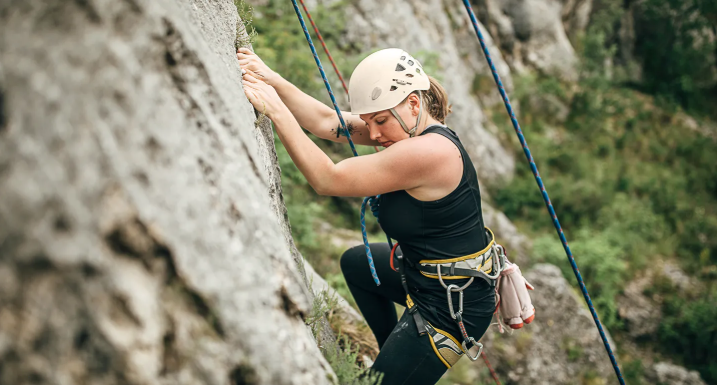

Some people say that the higher you climb, the harder you fall. But they probably wouldn’t be rock climbers. This week, we’re exploring the sport, science and art of rock climbing.
It is estimated that nine million people in the United States rock climb. Millions more take part in the activity around the world. Some do it just for personal satisfaction. Others compete. Rock climbing can be dangerous. However, there are many methods and protective devices that can enhance climbers’ safety.
Climbing requires strength, control, and good balance. Climbers must pull themselves straight up the face of very high rocks or walls. Therefore, they must be strong enough to support their own weight. Climbers also sometimes have to hold on to rocks using only their fingers or toes.
There are several types of rock climbing. Traditional rock climbing is done outside. Climbers wear ropes and attach devices to the rocks as they climb hundreds of metres up. They also connect their ropes to these devices. If a climber slips, the rope can prevent them from falling.
Sport climbing is similar. However, in this case, the protective devices are permanently fixed to the rock. There is also indoor climbing. These are rock walls made of wood or concrete with places for the climber’s hands and feet.
Ice climbing is exactly as it sounds. Instead of rocks, people climb glaciers or frozen waterfalls. They use special equipment designed for ice.
Then there’s bouldering, which involves climbing rocks between three and seven metres high. This is a quicker and more intense form of climbing. Many climbers like bouldering because they need less equipment. They often only need special shoes and chalk. All climbers use chalk to keep their hands dry.
Most rocks have cracks, holes, and projections. Climbers use these as footholds and handholds. Sometimes, the rock curves into an overhang. In this case, the climber has to move sideways while moving forward in order to avoid hanging upside down completely.
Climbers use their legs for climbing. They try not to pull themselves up with their arms or hands. Their arms and hands are used for positioning and maintaining balance. Climbers often need to secure their bodies to the rock using just one small finger hold.
People almost always climb in groups of two or more. Climbing alone, or ‘solo climbing’, is extremely dangerous. Even expert rock climbers say that only the very best in the sport should attempt it.
In a group climb, the first climber is the lead climber. They have a rope attached to their harness. This goes around the climber’s middle and between their legs. The second climber is called the belayer. The lead climber’s rope goes through a belay device. This is attached to the belayer’s harness. The belayer gives the lead climber more rope as he moves up the rock.
As he climbs up, the lead climber attaches his rope to devices in the rock. If they fall, they are protected by the rope connected to the devices and the belayer. However, the lead climber can only do this for about twenty-five metres — the length of the climbing rope. If the lead climber were to fall from a greater height, the belayer would be unable to bring them down. Later, the lead climber and the belayer swap roles. They meet where the first climber stopped. Then they start climbing again.
Sarah Bowman is a twenty-six-year-old rock climber from Alexandria, Virginia. She started climbing a year and a half ago. Her first experience of the sport was probably not the usual kind. It was during a visit to Alaska.
Sarah Bowman: ‘So, I ran a marathon, and two days later I went ice climbing on a glacier. Then I decided to come back home and see if there was a gym, and so on.”
She says she fell in love with the sport.
Sarah Bowman: ‘It’s sort of like a world of its own. There’s no other sport where you’re constantly going up and down. Everything else is on the ground. In basketball, you go up a little bit, but nowhere near as much. I think most people either love it or hate it. There’s really no in between.’
Miz Bowman continued her training.
Sarah Bowman: ‘I’m also now a wilderness EMT, which is totally a good thing to have when you’re out rock climbing.’
Miz Bowman works at an indoor climbing centre. She says that all climbers go to these centres in the winter, when it is too cold to climb outdoors. Indoor centres have many different paths that climbers can use to reach the top of the walls. These are marked by tape of different colours. If you start on a coloured path, you must continue to use only the hand and footholds marked with that colour. The different paths have different levels of difficulty. While our reporter was there, Sarah Bowman achieved a personal best.
The Sportrock Climbing Centre is busy, even at 9.30pm on a Monday night. An equal number of young men and women crowd around several different climbing walls. Climbers stretch their bodies in ways that seem impossible while hanging in positions that seem to defy the laws of physics. They try to move up the wall as silently as possible. Sarah Bowman says that being quiet is an important climbing skill. However, fans on the ground cheer them on as they climb.
This past summer, the rock-climbing world mourned the loss of one of its greatest stars. John Bachar was fifty-two years old when he fell from the Dike Wall near his home in Mammoth Lakes, California. He was doing what he was famous for — free solo climbing. This involves climbing alone and without protection.
Born in Los Angeles, John Bachar became famous in Yosemite Valley, California. This area of Yosemite National Park is the traditional international centre of rock climbing.
Mr Bachar began free solo climbing in the 1970s. He was a member of a group of climbers known as the Stonemasters. Another climber, John Lang, dared Bachar to free-solo an area called Double Cross in Joshua Tree National Park in California. Bachar accepted the challenge and never looked back.
By 1981, Bachar had proposed a dare himself. He offered ten thousand dollars to anyone willing to accompany him on a one-day climb without a rope. No one accepted.
Dean Fidelman, a professional rock climber and close friend of John Bachar, was one of the people we spoke to. We spoke to Mr Fidelman while he was climbing. He said that John Bachar often compared himself to a dancer who was always refining his technique. Mr Bachar was known for his slow, smooth, controlled movements while climbing.
Mr Fidelman said that he believes a climber’s ego can be their worst enemy. He said that rock climbing is a high-risk sport in which many people overestimate their abilities and underestimate the difficulty of the climb.
A recent study shows a sharp increase in rock-climbing injuries between 1990 and 2007. The study was conducted by the Center for Injury Research and Policy at Nationwide Children’s Hospital in Ohio. It was published in the American Journal of Preventative Medicine. It found that the number of people treated for rock climbing injuries in American hospitals had increased by sixty-three percent.
It said that 40,000 people were treated in emergency rooms. The most common injuries were broken bones and sprains to the legs and feet. Ankle injuries were the most common.
The climbers in the study were aged between two and seventy-four. The average age was 26. 56% of the injuries were to people aged twenty to thirty-nine. Women accounted for 29% of those injured. This is higher than in previous rock climbing studies.
Like many other sports, rock climbing can be dangerous. However, many people think it is worth it. John Bachar said that climbing made him feel as though he were on another planet. Dean Fidelman says it is a continual challenge and a beautiful form of movement. Sarah Bowman has just started climbing.