
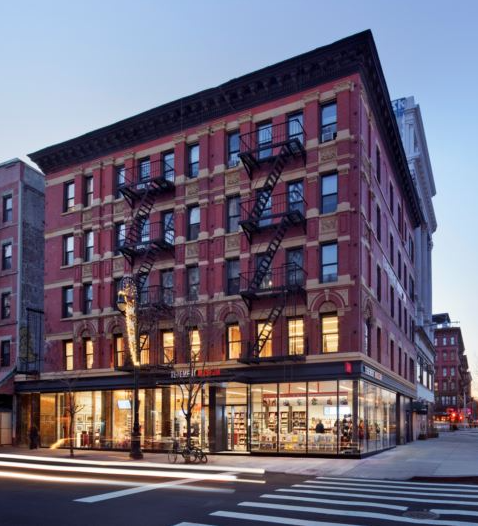

Today, I am going to tell you about a museum in New York City. It celebrates the people from different countries who came to live in the United States many years ago.
The Lower East Side Tenement Museum is one of New York’s smaller museums. It allows visitors to experience what life was like for early immigrants to the United States. The museum occupies a building at 97 Orchard Street. It was built in 1863 by a German immigrant named Lucas Glockner. Before investing his money to develop a property, he worked as a tailor making clothes.
His tenement building was one of many constructed in New York to capitalise on the growing demand for housing among immigrants.
The word ‘tenement’ comes from the Latin ‘tenere’, meaning ‘to hold’. Tenement buildings held many rooms in which different families lived.
The word is not used much anymore in the United States. When people use it today, they usually mean an old, overcrowded building where poor families live in terrible, unhealthy conditions. However, in the 19th century, the word simply meant a building in which many families lived.
Later, many immigrant families improved their living conditions by moving from the Lower East Side to other areas of New York City. Some lived in similar buildings, but the living areas were cleaner and larger. They did not want to call these buildings ‘tenements’, so they called them ‘apartment buildings’ instead.
Historians say that more than half of New York’s population lived in tenements in 1863.
The building at 97 Orchard Street is an example of the kind of space where families lived. The front room was the largest. It was the only room with a window. Behind it were a kitchen for cooking and a small bedroom for sleeping. The apartment had no running water and no bathroom, toilet or shower. Six places for leaving body waste were located in the backyard, next to the only place to get drinking water. These unhealthy conditions led to the spread of disease.
Over the years, New York City officials have passed laws aimed at improving conditions in tenements. The owners of 97 Orchard Street installed gas lighting in the building in the 1890s.
They installed water and indoor toilets in 1905 and electricity in 1924. After this, they refused to make any further improvements. They closed the building in 1935. In 1998, the federal government declared the building a protected National Historic Site.
Museum officials researched the history of the building and its twenty apartments. They found over two thousand items belonging to the people who had lived there. These included kitchen utensils, medicine bottles, letters, newspapers, coins and pieces of fabric. They also learned the stories of many of the seven thousand people from over twenty countries who had lived there. They also spoke to people who had lived at Ninety-Seven Orchard Street as children and recorded their memories.
Using this information, museum officials recreated some of the apartments as they would have looked during different time periods in the building’s history.
Visitors to the Lower East Side Tenement Museum can see these apartments. Let us join one of the guided tours. First, we climb several flights of worn stairs. It is a very hot day, and we can feel the heat in the dark, narrow hallway.
We now enter the apartment of the Gumpertz family. They were Jewish immigrants from Germany who lived here in the 1870s. On 7 October 1874, Julius Gumpertz got dressed for work, left the building, and never returned. He left his wife, Nathalie, and their four children, aged between eight months and seven years.
Mrs Gumpertz had to support her children by making clothes in her apartment. She earned around eight dollars a week. This was enough to cover the monthly rent and send her children to school. The apartment contained a sewing machine and other tools similar to those used by Nathalie Gumpertz in her work. She converted the largest room into her workspace. That was where she met people who wanted clothes made or repaired.
The next apartment we visit belonged to the Baldizzi family. They came from Italy and were Catholic. In 1928, Adolfo Baldizzi, his wife Rosaria, and their two children moved to Orchard Street. Their daughter, Josephine, liked to help others. Every Friday night, she would turn on the lights in the nearby Rosenthal apartment. The Rosenthals could not turn on the lights themselves because it was the start of a Jewish holy day, when no work was permitted.
Here is a recording of Josephine Baldizzi. In it, she talks about how she felt each week when she saw Mrs Rosenthal in the window, motioning for her to come and turn on the lights.
Josephine Baldizzi: ‘It made me feel very proud to be chosen to do that job. I felt honoured that she had chosen me to do that job for her. I can still see her to this day — the vision of her in that window. It has never left my memory.’
Now, let’s visit the apartment of the Rogarshevsky family from Lithuania. They moved to 97 Orchard Street between 1907 and 1910.
Abraham and Fannie Rogarshevsky had six children. Abraham developed tuberculosis and died in 1918.
Fannie Rogarshevsky was faced with the same problem as Nathalie Gumpertz: How could she support her family and continue to live in the apartment? She convinced the building owner to let her clean apartments and do other work in exchange for rent.
Mrs Rogarshevsky continued to live in this building and clean its rooms even after the other tenants were evicted in 1935. She moved out of 97 Orchard Street and into a nearby public housing project in 1941.
Now, we enter the apartment of the Levine family. They were Jewish immigrants from Poland. Jennie and Harris Levine moved into the building in the early 1890s. They lived there for over ten years. During that time, Mrs Levine gave birth to four children. Her husband and his employees made clothes in the front room.
Here we see the room as it looked after the workers had gone home at the end of the day. We hear stories about the many immigrants who worked in New York’s clothing industry.
Another apartment is a living example of history. This one belonged to the Confino family in 1916. Abraham and Rachel Confino came to New York from Turkey. They were Sephardic Jews, whose ancestors were born in Spain, North Africa, or the Middle East.
An actress playing thirteen-year-old Victoria Confino welcomes us. She recounts Victoria’s experiences of living in the building. She explains the Sephardic language, Ladino, and sings part of a sad Ladino song.
Victoria Confino: “Oh, it’s a very mixed-up language. It’s a bit like Spanish… we call it Judeo-Espanyol… and it contains elements of Turkish and Hebrew, too. It’s a mixture of many different languages.”
Writer Jane Ziegelman has recently published a book exploring food culture from the perspective of five families who lived at 97 Orchard Street. Her book is called 97 Orchard: An Edible History of Five Immigrant Families in One New York Tenement’.
Ziegelman explores the many food traditions that German, Irish, Italian, and other immigrants brought with them to the United States. She also demonstrates how these traditions have influenced American cooking.
For example, it was the Germans who introduced the tradition of pale beer to the United States. She also discusses a German restaurant in New York that served a meat dish known as ‘hamburger steak’. This dish would evolve into the hamburger, which is now considered a truly American food.
Ms Ziegelman suggests that the Irish were less protective of their culinary heritage. This is because they came from a country plagued by poverty and failing potato harvests. She says that Italians, on the other hand, felt very strongly about the quality of their food. They were willing to pay extra for oils, dried vegetables, and tomato products imported from Italy.
Ms Ziegelman also identifies two foods that united Americans, regardless of their nationality or social background: oysters and fruit pies.
From the nineteenth century onwards, she says, immigrants would take on the most difficult jobs that non-immigrants would not do. These included working as food vendors, brewers, bakers, butchers and restaurant staff. Her book illustrates the crucial role that the hard work of immigrants played in feeding America.