
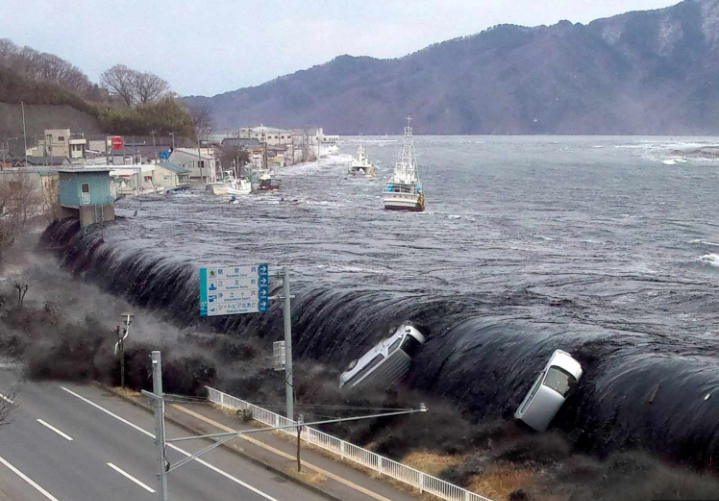

The Japanese call them ‘harbor waves’. ‘Tsunami’ is a two-character Japanese word. ‘Tsu’ means ‘harbour’ and ‘nami’ means ‘wave’. Tsunamis occur after an earthquake strikes near or under the ocean. The earthquake displaces a large amount of water in the ocean. The waves then rush inland quickly and powerfully, causing death and destruction.
According to scientists, strong earthquakes under the sea are responsible for eighty to ninety percent of all tsunamis. Volcanic explosions can also cause tsunamis. So could a large piece of land sliding into the water, or a meteorite striking the ocean. There have been three major tsunamis worldwide in the past seven years. On average, a major tsunami occurs only once every ten years.
In the deep ocean, a tsunami wave may only rise about three hundred millimetres. In fact, people on a boat at sea may not even realise that a tsunami wave has just moved past them. Tsunamis are long waves that can travel great distances very quickly — some move at over eight hundred kilometres an hour. They can cross an ocean in less than a day.
Some people may not understand the difference between a tsunami and a tidal wave. Tides are the normal rise and fall of saltwater levels against the coast. Tsunamis are extreme events, not normal tides. A tsunami is not just one wave, but a series of waves. Some of these waves can be enormous. According to scientists, the first wave is often not the largest. This is usually the third or fourth wave. These waves can be anywhere from five minutes to one hour apart.
How are tsunami waves caused? The ocean floor is made up of tectonic plates. These large areas are constantly in motion. Usually, the plates simply rub against each other along a fault line. Sometimes, however, one plate subducts — or slides under — another. Over time, a huge amount of pressure builds up on the plate that has slid under the other. This results in an earthquake when it suddenly springs up. Large earthquakes in subduction zones are responsible for most ocean-wide tsunamis, such as the recent tsunami in Japan.
Scientists can measure the strength and location of earthquakes because there are hundreds of seismic monitoring stations around the world. If a strong earthquake occurs near or in the ocean, computers quickly measure its length, depth and location. These measurements help to predict the strength of any resulting tsunami.
When a tsunami forms, the wave spreads out quickly. As it approaches land, the force of the water increases. People near the coast may hear a loud sucking sound or a noise similar to that made by a train or aeroplane. Then, a ‘drawback’ may occur. Suddenly, a large area of the coastline is left with very little water, as the water moves away from the land. However, sometimes there is no drawback and high waves approach the land quickly with no warning. Some tsunami waves can reach heights of up to thirty metres.
Three months ago, the tsunami that hit Japan destroyed houses, office buildings, cars, trucks and even large boats. Thousands of people were killed. However, many more would have died if it were not for a tsunami warning issued by the Japanese Meteorological Agency. This was issued just three minutes after the 9.0-magnitude earthquake struck off the north-eastern coast of Japan. This was the fourth most powerful earthquake ever recorded worldwide and the worst to hit Japan.
The tsunami waves that followed the earthquake hit almost immediately. In some areas, they reportedly reached heights of up to nine metres. Forty percent of Japan’s coastline is protected by concrete sea walls. However, these walls were not designed to withstand such high waves. In some areas, the sea walls were only three metres high.
Japan has one of the best tsunami early warning systems in the world. There are more than four thousand seismic intensity meters across the country to measure earthquakes. These meters provide information within two minutes of an earthquake striking. Information about the earthquake’s strength and epicentre can be obtained in less than three minutes.
Japan experiences frequent earthquakes. Some of these earthquakes cause powerful tsunamis. Japan has suffered hundreds of tsunamis over the years. However, few were as powerful as the tsunami that hit the north-east of the country in March.
The National Oceanic and Atmospheric Administration (NOAA) is a United States government agency. NOAA officials use equipment on the ocean floor and surface to measure tsunamis. These great waves are difficult to predict.
NOAA spends $40 million a year in an effort to protect the United States from tsunamis. The country has operated a tsunami warning system for forty years. It runs two tsunami warning centres: one on the Hawaiian island of Oahu and one in Palmer, Alaska. Jenifer Rhoades supervises NOAA’s Tsunami Programme.
JENIFER RHOADES: ‘First, we acquire seismic data, which we start doing within about ten seconds of an earthquake. We use this to generate the initial product. Based on the seismic data alone, we determine the size and magnitude of the earthquake, as well as its location.”
The NOAA says that tsunamis can travel much faster than anyone can run. The agency says that people living in coastal areas need to recognise the signs of a possible tsunami. These include hearing a roaring or sucking noise, seeing the ocean suddenly recede or rise, or experiencing a strong earthquake lasting more than twenty seconds.
The safest thing you can do, says NOAA, is to move to higher ground at once or go to the top of a tall, sturdy building. You should not wait to hear a tsunami warning. Once a tsunami wave has reached land, you should not return to the coastline until local officials say it is safe to do so. This is because tsunamis often consist of multiple waves, with subsequent waves potentially being higher than the initial one. There can be as much as an hour between waves. You may have to stay away from low-lying areas for up to twenty hours after the initial warning.
Jenifer Rhoades of NOAA says the agency spends a lot of time and money educating people in areas where tsunamis may strike. She says it is important for people living in these areas to understand what she calls ‘nature’s warning signs’.
JENIFER RHOADES: ‘You can have a very near-shore earthquake that will result in a tsunami in minutes. The time it takes us to issue a warning may exceed the time it takes for the first wave to arrive. In those cases, we tell people in those communities that if the ground shakes for more than twenty seconds and they cannot stand up during the earthquake, they should stay where they are until it is over, but as soon as it is, they should move to higher ground.”
On 26 December 2004, a powerful earthquake and tsunami struck the Indian Ocean. More than two hundred thousand people on two continents were killed.
Following the tsunami, NOAA and the United States Geological Survey were allocated additional funding to enable them to issue tsunami warnings more quickly. NOAA can now provide tsunami warnings in an average of six minutes, compared to fifteen minutes previously. In some areas, NOAA can provide these warnings in under three minutes. This reduction could help save many lives.
However, without a means of publicising these warnings, such information is of little use. Local officials need to have a warning system in place. They should also have a plan for evacuating people from threatened areas. Officials are responsible for broadcasting warnings as quickly as possible by any means necessary.
The Helmholtz Association of German Research Centres says it has developed new tsunami warning technology. The group says that earthquake shock waves reach a measuring instrument more quickly today than in the past. However, it is difficult to interpret a wave when it is nearby. To address this issue, the designers have developed computer software. They claim that the programme can identify the source, location and magnitude of powerful earthquakes within two minutes.
The Indian Ocean tsunami of 2004 was one of the worst ever recorded. However, the Pacific Ocean has experienced more of these deadly waves than other oceans. Experts estimate that sixty percent of tsunamis occur there. The NOAA says that tsunamis cannot be prevented. However, the damage caused by tsunamis can be reduced by ensuring people are prepared and by providing timely warnings and an effective plan of action.