
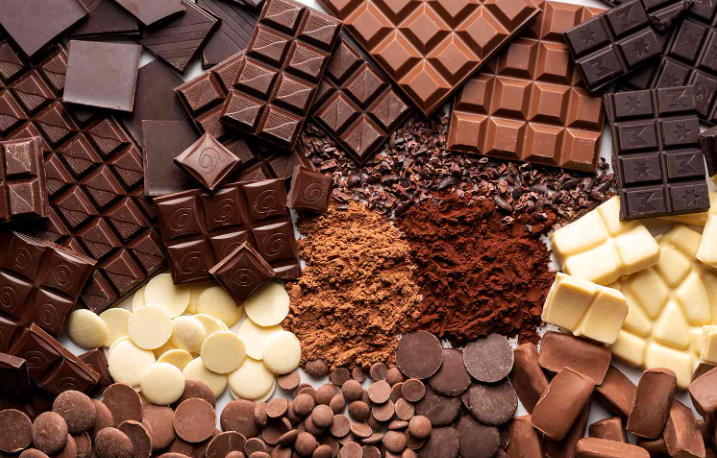

Researchers have long known that chocolate is good for the heart. In this article, we report on a study that explains why. We will also tell you about the health benefits of dark chocolate.
The Tasty History of Chocolate
The history of chocolate begins with a plant whose scientific name, Theobroma cacao, means ‘food of the gods’. People have been enjoying the rich flavour of chocolate, a product made from this plant, for centuries. Historians believe that the Maya people of Central America first learned to cultivate cacao plants around 2,000 years ago. They took the cacao trees from the rainforests and grew them around their homes. They cooked the cacao seeds, then crushed them into a soft paste. They mixed this paste with water and flavourful spices to make an unsweetened chocolate drink. Cacao and chocolate played an important role in Maya culture. Images of cacao plants often adorn Maya buildings and art objects. Ruling families drank chocolate at ceremonies. Even poorer members of Mayan society could enjoy the drink occasionally. Historians believe that cacao seeds were also used in marriage ceremonies to symbolise the union between husband and wife.
The Aztecs in present-day Mexico also prized chocolate. However, the cacao plant could not grow in the area where they lived. So they traded to obtain it. They even used cacao seeds as money to pay taxes or offer to the gods. Only the wealthiest members of Aztec society could afford to drink chocolate, as cacao was so valuable. Montezuma, the Aztec ruler, is said to have consumed 50 cups of chocolate daily. Some experts believe that the word ‘chocolate’ comes from the Aztec word ‘xocolatl’, meaning ‘bitter water’ in the Nahuatl language. However, others believe that the word ‘chocolate’ was formed by combining Mayan and Nahuatl words.
After his trip to Central America in 1502, the explorer Christopher Columbus brought cacao seeds to Spain. However, it was the Spanish explorer Hernán Cortés who realised that chocolate could be a valuable commodity. In 1519, Cortés arrived in Mexico. He believed that the chocolate drink would become popular with the Spanish people. After the Spanish soldiers had defeated the Aztec empire, they seized the cacao supplies and sent them home. Spain then started cultivating cacao in its American colonies to meet the high demand for chocolate.
Initially, only the wealthy in Spain enjoyed a sweetened version of the chocolate drink. Later, the popularity of the drink spread throughout Europe. The English, Dutch and French then started planting cacao trees in their colonies. Until the 18th century, chocolate was an expensive drink reserved for the wealthy. During the Industrial Revolution, new technologies helped to reduce the cost of producing chocolate.
Cacao trees are now grown by farmers in many countries in Africa, Central America and South America. These trees thrive in the shaded areas of rainforests near the equator. However, these trees can be difficult to cultivate. They require precise amounts of water, warmth, soil and protection. After around five years, the trees start producing large fruits called ‘pods’, which grow near the trunk. The seeds inside these pods are harvested to make chocolate. Growing cacao is hard work for farmers. They sell their harvest on a futures market. This means that economic conditions beyond their control can affect how much money they earn.
Today, officials from the chocolate industry, activists and scientists are working alongside farmers. Together, they are trying to ensure that cacao can be cultivated in a manner that is both fair to farmers and environmentally safe. In order to become chocolate, cacao seeds undergo a lengthy production process in a factory. Workers must sort, clean and cook the seeds. They then break off the seeds’ covering so that only the inner fruit, or ‘nibs’, remain. The nibs are then crushed into a soft substance called chocolate liquor. This is then separated into cocoa solids and a fat called cocoa butter.
Chocolate makers have their own special recipes for combining chocolate liquor with exact amounts of sugar, milk, and cocoa fat. They then crush the mixture into a fine powder. The mixture then undergoes two more processes before being shaped into moulds. Chocolate production is big business. The market value of the global cacao crop exceeds five billion dollars each year. Chocolate is particularly popular in Europe and the United States. Americans eat an average of more than five kilograms of chocolate per person every year. Speciality shops selling expensive chocolates are also very popular. Many of these shops offer chocolate lovers the chance to sample chocolates from different regions around the world.
Dark chocolate and heart health
Researchers have long known that chocolate, especially dark chocolate, is good for the heart. Now, they know why. As well as tasting good, dark chocolate has been found to protect against heart disease in two ways: it restores mobility to hardening arteries. It also prevents white blood cells from gathering on blood vessel walls. Both of these conditions can lead to plaque formation. This can block the flow of blood and cause heart disease.
The findings were reported by researchers from the Netherlands. They studied 44 middle-aged men who were considered overweight. Over two periods of four weeks, the men ate 70 grams of both dark and milk chocolate every day. The heart-healthy substance in chocolate is an organic compound called flavanol. Flavanols are also found in vegetables, fruits, and green tea.
Gerald Weissmann is with the FASEB Journal, which published the study findings earlier this year. He says that the researchers found that there is something about the flavanols in dark chocolate that makes it more appealing than milk chocolate. “In this controlled study — the first of its kind — the same amount of flavanol was given in both dark and regular chocolate. Lo and behold, the men didn’t consume different amounts of flavanols. But they ate more of the dark chocolate because they liked it better.’
Mr Weissmann says the researchers asked the men in the study to describe the smell and taste of dark chocolate.
“So, the taste and psychological aspects of dark chocolate improved the elasticity and response of the arteries to blood flow, the way neutrophils (white blood cells) stick to the lining of blood vessels, and markers of inflammation.”
Knowing that dark chocolate is good for the heart also seemed to make the men feel less guilty about eating it. Researchers may someday develop a treatment that provides the same health benefits as dark chocolate. But even if they do, we’re sure that eating a piece of dark chocolate will still be more enjoyable.
Scientists to study health benefits of chocolate
Dark chocolate has been shown to help prevent heart disease. However, eating too much of it may cause weight gain. Now, scientists are looking for a way to put dark chocolate’s beneficial ingredients into pills. This would allow us to enjoy the health benefits of dark chocolate without the weight gain.
Cacao contains flavanols which may reduce the risk of heart attacks and strokes. These chemicals may lower blood pressure and cholesterol levels and improve the body’s use of insulin. Insulin helps to control the amount of glucose, or sugar, in the blood.
Steve Koumanelis is a chocolatier. Based in Washington, D.C., he makes and sells chocolate treats, and he says that dark chocolate is becoming an increasingly popular product. “A lot of people are gravitating towards it because they decide they love it and have read about its health benefits.”
However, these health benefits have yet to be confirmed by studies involving large numbers of people. Also, many flavanoids are destroyed during the manufacture of chocolate, while sugar and fats are added to improve the taste.
Scientists want to understand the benefits of flavanols before they are altered during production. They have announced plans for a four-year study involving 18,000 adults. The participants will consume small quantities of pure cacao flavanols. This is believed to be the largest study of its kind. Jo-Ann Manson works at Brigham and Women’s Hospital in Boston, Massachusetts. She is the lead researcher on the study.
“These cocoa flavanol capsules will avoid the calories, sugar and saturated fat found in chocolate.”
The flavanols will not affect the taste.
The subjects of the new study will be separated into two groups. One group will take pills containing flavanols. The other group will take placebo pills containing nothing but perhaps some sugar.
Whatever the outcome of the study, chocolatier Steve Koumanelis is not concerned about the future of his business.
“People enjoy the experience of biting into a piece of chocolate, whatever their favourite type is.”
The flavanol benefits trial has just begun. For now, people will have to get their flavanols the tasty way — by eating dark chocolate!