
Today, we are visiting a small museum in Maryland, USA. It is called the National Cryptologic Museum. There, you will find information that was once classified.
The museum is located on Fort George G. Meade, a military base near Washington, D.C. The museum tells the story of cryptology and the men and women who have worked in this unusual profession.
The word ‘cryptology’ comes from the Greek ‘kryptos logos’. It means ‘hidden word’. Cryptology involves writing or communicating in ways designed to hide the meaning of your words.
The museum has many examples of equipment that was once used to keep information secret. It also has equipment that was developed to decode secret messages. The method of hiding exact meanings is called coding. Throughout history, people have used secret codes to protect important information.
In 2012, the National Cryptologic Museum celebrated 60 years of cryptologic excellence. One event marked the 60^(th) anniversary of the National Security Agency. Two former NSA employees shared their memories of operating a code machine called Sigaba.
A variety of skills are required to send and translate secret messages. The most important of these is knowing how to keep a secret. Helen Niebouar worked in Washington during the Second World War and for the United States military in Japan afterwards.
‘The officers in charge of the code rooms would constantly remind us to keep our mouths shut. They’d say, ‘Don’t mention where a message came from, and certainly don’t mention what it said.’ They’d say, ‘Now, when you have top-secret clearance, that’s what it means: top secret. Keep your mouth shut.’ So we were reminded a lot.’
The Sigaba machine encoded plain information, turning it into a secret language that could only be understood by those who had the necessary equipment. The one that Helen Niebouar operated was a complex device. The National Cryptologic Museum displays both early and modern tools that have been used for secret communications.
One display at the museum explains how the Americans attempted to decipher Japanese military information during the Second World War. Japan’s navy used special machines to convert written information into secret codes. This coded information was then sent by radio to naval vessels and military bases. This included secret military plans and orders.
Japanese naval leaders believed that no one could read or understand the secret codes. They were wrong. Americans were working very hard to crack the Japanese code. The United States urgently needed to break the code in order to find out what Japan was planning.
In 1940, an American woman named Genevieve Grotjan noticed that the same information was appearing repeatedly in Japanese coded messages. At the time, she was a civilian employed by the government in Washington, D.C. Her discovery enabled the United States to decipher secret Japanese diplomatic messages.
Once the code had been broken, it became possible to study messages from the Japanese ambassador to Germany and his superiors in Japan.
This helped the United States prepare for a potential war with Japan in the Pacific. Nevertheless, the United States was taken by surprise by the Japanese attack on Pearl Harbor in Hawaii. The Japanese military did not send coded military information to the country’s diplomats. Military messages used different codes.
Following the attack on Pearl Harbor, American naval officer Joseph Rochefort worked tirelessly to decipher the Japanese navy code. He was stationed at the American base in Pearl Harbor. This was in early 1942. The American naval commander in the Pacific Ocean was Chester Nimitz. His forces were much smaller than the Japanese naval forces. The Japanese had also won many victories.
Joseph Rochefort had spent several months trying to decipher the secret Japanese naval code, JN-25. Once he had deciphered it, he would be able to provide Admiral Nimitz with valuable information. The admiral could then use this information to plan battle strategies. By early 1942, Mr Rochefort and his team could decipher less than 20 per cent of the JN-25 code.
From the beginning of 1942, the code referred to a place called ‘AF’. Mr Rochefort felt that the Japanese were planning an important battle aimed at ‘AF’. But where was ‘AF’? Several weeks later, he and other naval experts informed Admiral Nimitz that they believed the ‘AF’ referenced in the Japanese code was the American-held island of Midway. Admiral Nimitz said that he needed more information in order to prepare for such an attack.
The Navy experts decided to trick Japan. They instructed the American military force on Midway to broadcast a false message. This message would claim that the island was experiencing issues with its water-processing equipment. It asked for fresh water to be sent to the island immediately. This message was not sent in code.
Several days later, a Japanese radio broadcast in the JN-25 code stated that ‘AF’ had limited water supplies.
Joseph Rochefort now had the evidence he needed. ‘AF’ was now known to be the island of Midway. He also informed Admiral Nimitz that the Japanese were planning to attack Midway on 3 June.
The admiral secretly moved his small force to an area near Midway and waited for the Japanese navy. The ensuing battle was a resounding American victory. Experts now say that the Battle of Midway marked the beginning of American victory in the Pacific. This success was made possible by Joseph Rochefort’s ability to decipher the Japanese code, enabling him to uncover the meaning of the letters ‘AF’.
No American code has ever been broken. Perhaps it never will be. It was used in the Pacific during the Second World War. For many years, the government refused to discuss this secret code. Take a moment to listen to this unusual code. Then you will understand why the Japanese military forces could never decipher it.
The code is sung in the voice of a Native American. The man you just heard was singing a simple song in Navajo. Very few people outside the Navajo Nation are able to speak their language, which is extremely difficult.
At the start of the Second World War, the United States Marine Corps recruited members of the Navajo tribe to train as code talkers.
According to the Cryptologic Museum, the Marine Corps Code Talkers could translate an English sentence into Navajo in about 20 seconds. A code machine would have needed about 30 minutes to do the same work.
The Navajo Code Talkers took part in every Marine battle in the Pacific during the war. The Japanese were highly skilled at breaking codes. However, they were never able to decipher what they called ‘The Marine Code’.
The first code talkers were eight members of the Choctaw tribe. During World War One, they worked in teams using their native language, which was unknown in Europe. One of them would translate a message from English into their native language and send it by radio. Another would then receive the message and translate it back into English.
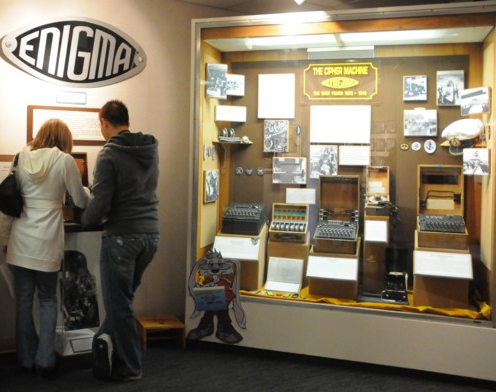
The Cryptologic Museum has many pieces of mechanical and electrical equipment used to turn words into code. It also has an almost equal number of examples of machines used to decode messages.
Perhaps the most famous example is the Enigma, a German code machine used during World War Two. The word ‘enigma’ means a puzzle or problem that is difficult to solve.
The German military used the Enigma machine to send orders and plans. The United States, Britain and Poland cooperated in learning to decrypt messages sent using the Enigma machine. Decoding the Enigma information required the efforts of thousands of people and cost millions of dollars. However, this investment of time, effort and money resulted in the war against Nazi Germany ending sooner.
The National Cryptologic Museum is part of the National Security Agency. One of the agency’s many roles is to provide cryptographic services to the United States government. The NSA’s work is not open to the public. However, the museum tells the stories of the men and women who worked for the NSA, even after their work ceased to be classified.
Each section of the museum illustrates the importance of this secret, challenging work. Visitors say that seeing the equipment and reading the documents, which were once highly important and top secret, is very interesting and fun.