
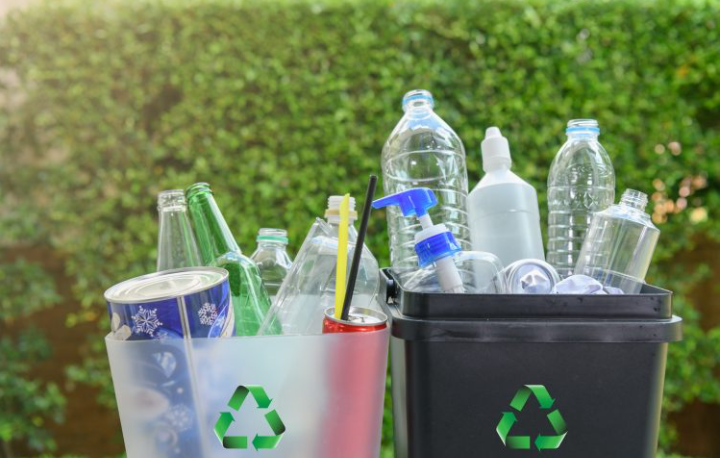

Today, we follow plastic bottles and other plastic items as they are taken to one of the largest recycling centres in the United States. We also report on the impact of the tax on plastic bags in the nation’s capital.
Remember: reduce, reuse, recycle. Recycling has become part of American life. It is also an important part of the waste processing industry. In fact, many cities and towns in the United States now have recycling programmes.
To find out how such a programme works, we will visit a recycling centre in Maryland, in the east of the country.
The recycling bin in homes and offices is often the final destination for empty containers. However, for paper, plastic, cardboard and cans, it marks the start of a journey spanning thousands of kilometres. Yehenew Gedshew directs a recycling centre near Washington, DC.
‘As long as people throw their rubbish away, we have a job.’
His recycling centre processes around 35 tonnes of material per hour. How does it manage to process that much every hour? Yehenew Gedshew says the business is highly organised.
‘First, dump trucks bring materials to our site. They dump it on the tipping floor. The material then goes to the first screen, where the cardboard and other materials are sorted out.”
The rest of the material then goes onto a conveyor belt that carries the glass and plastic to the final screening area. The glass is crushed and the plastic is sorted and flattened.
‘This is a very sophisticated machine. That belt brings the material down to the bunker. The plastic goes into the bunker and from there it goes to the baler where it is baled and shipped out.
Local recycling programmes often require people to separate plastics, paper and glass. However, Yehenew Gedshew says that the sorters at his recycling centre do all that work. He says the centre ships most of its plastic to a processing centre in North Carolina, which is more than 500 kilometres south. There, mountains of bottles are turned into piles of plastic. They are ready to be melted and shaped into something new.
From the shop shelf to the recycling bin and beyond, plastic bottles spend a lot of time on the move. So have we. This time, we’re going to Fayetteville, North Carolina. The city is home to the Clear Path Recycling Centre. It is one of the largest plastic recycling centres in the United States. Jay Chilton is in charge of the centre.
‘On an average week, we receive between one and one-and-a-half million pounds of bottles into the plant.’
In metric terms, that equates to 454,000–680,000 kilograms. The Clear Path Recycling Centre receives eight to ten trucks a day. This equates to over 18,000 kilograms of plastic daily. The goods arrive at the centre in large piles or bales, similar to those at the recycling centre in Maryland.
‘These bales, on average, weigh about 900 lbs (400 kg), but can range from 600 lbs (270 kg) to 1,500 lbs (680 kg) in this configuration. This accumulation represents nearly 10–15 weeks of deliveries.’
Not far from Clear Path Recycling is a huge storage area for plastic items. They enter the recycling centre to begin the process that will transform them.
‘This is where the whole bottles enter the bottle washer. It’s just like the front-loading washing machine in your house. It’s just a lot longer and bigger.’
Hot water washes the paper labels off the drink bottles and removes any dirt. The plastic is broken up into what the plastics recycling industry calls ‘PET flake’. Another centre will buy the flakes to melt and mould them into something else. The flakes fill trucks and are sometimes stored in silos, similar to those used by farmers to store grain.
‘These silos hold roughly 300 metric tons of PET flake. The one we’re standing on now has about 150 metric tons of flake in it, and there are three of these.’
Add up the numbers — almost one kiloton of plastic flakes are waiting to be transformed into something new.
Plastic bottles are constantly on the move. Machines mould them and fill them with our favourite drinks. Once we have finished drinking, machines destroy the bottles and turn them into new ones. Their journey never ends. But our journey has come to an end in Wilson, North Carolina.
In our programme, we describe the journey of plastic bottles from stores to recycling bins and then to recycling centres. The bottles are broken down into small pieces and put into bags. Now, we will witness the rebirth of a plastic bottle.
Mark Rath is a supervisor at Peninsula Packaging. At his company, pieces of plastic are made into products such as takeaway trays for food stores and restaurants.
‘This will become a plastic sheet, and eventually a thermoform product,’ he explains.
Peninsula Packaging melts and flattens plastic so that it can be shaped and moulded. The process is complex.
‘We take clear plastic chips like these and put them in an oven where they cook for about three to four hours.’
The plastic is cooked at almost 200 degrees Celsius. Once melted, the plastic is made into takeaway trays or other food packaging. It is then wrapped and rolled up and taken to a ‘thermoform station’.
‘We unwind the plastic into a long oven, heat it again and then form it in a forming station. We’ll follow it through to see what happens.”
The process of recycling the plastic involves a vacuum, lots of pressure and — believe it or not — more recycling.
‘Imagine cutting out biscuits from a piece of dough on the counter. You get a biscuit and have all this dough left over. We put it back through, grind it up into little pieces, and put it back through the extrusion process.’
Mark Rath says that all the plastics in this packaging centre end up as containers in their next lives.
‘That’ll end up as the base for a fresh salad. I’m not sure where it goes, but it’ll end up somewhere with celery, carrots and tomatoes.’
Several days have passed, but the plastic bottle we bought in Washington, DC has now been transformed into a salad tray in North Carolina.
Many workers, hundreds of kilometres and tons of plastic are all part of a waste industry that seems to waste as little as possible.
Countless things affect the health of our environment. What we take from nature may not harm it as much as what we add to it. For years, many people have harmed the environment by throwing away plastic grocery bags. However, in Washington, a ‘bag tax’ has changed people’s behaviour and the way businesses affect the environment.
The Anacostia River flows through south-east Washington into the better-known Potomac River. The Anacostia is often referred to as the city’s ‘other river’. Tommy Wells is a member of the Washington, DC city council. He is concerned about the river’s health. He notes that the Anacostia has been labelled one of the ten most polluted rivers in the country.
Mr Wells says he was tired of seeing so many plastic bags in or near the river.
‘I wanted to do something that would get into people’s heads, not their pockets,’ he explains, ‘which is why we came up with a five-cent charge.’
Stores in Washington now charge people five cents — a nickel — for each disposable plastic bag. The money goes into the ‘Anacostia River Clean-Up Fund’. People who bring their own bags do not have to pay anything extra.
Has the ‘bag tax’ helped? Bret Bolin is with the Anacostia Watershed Society, a group working to protect the river.
‘Within three and a half months of introducing the bag fee, people were already reporting seeing far fewer bags in the river and at clean-up sites than in previous years.’
Councilman Tommy Wells agrees that the bag tax has been effective.
‘The amount of bags pulled out of the river reduced by 60 percent.’
The local government estimates that shops provided shoppers with almost 300 million bags in 2009. Mr Bolin says the bag tax caused this figure to drop sharply.
‘They were estimating around 55 million bags would be distributed in 2010, which would be an 80 per cent reduction — that’s amazing.’
The tax, which adds five cents to the cost of each bag, has added two million dollars to the River Cleanup fund in its first 10 months. Both Tommy Wells and Brent Bolin are pleased with the effect of the tax. However, when we spoke to some store owners and shoppers, we found that they were not so happy.
‘Ninety percent of people complained and said they didn’t want to buy the bags.’
Customers don’t like it at all.
They’ll pay $100 for alcohol, but not 5 cents for a bag.’
Other critics argue that, in difficult economic times, any tax is unfair to poor people and could cost jobs in the plastic industry. Nevertheless, many people still support the tax.
‘It’s easier.’
‘I carry my own bags.’
‘I mean… I don’t have to pay for them.’
‘I just bring my own bags since I have them.’
‘It’s free!’
‘Everybody brings their own bags now.’
However, supporters of the tax, such as Brent Bolin and Tommy Wells, argue that reducing the use of plastic bags is the only way to prevent them from polluting the environment.
‘You can’t keep pulling rubbish out of the river forever.’
‘Our city is so much more beautiful now that we don’t have these bags blowing around in the trees and polluting the environment.’
There is still much work to be done to clean up the nation’s capital and the Anacostia River. But change is taking place — five cents at a time.