
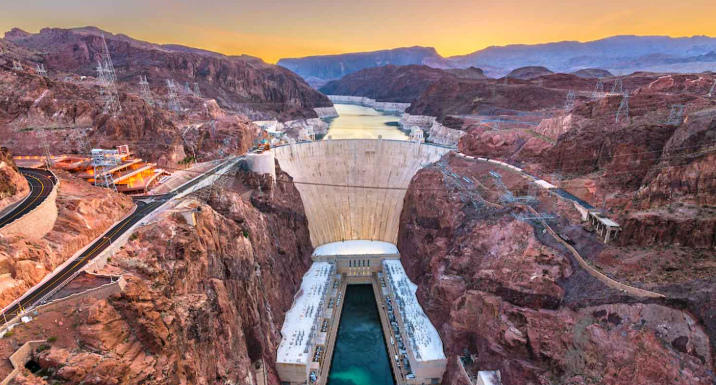

When work started on the Hoover Dam in 1931, it was the largest and most difficult structure of its kind ever built. A new bypass bridge near the dam, which opened this month, is also an engineering marvel.
However, our report on the Hoover Dam must begin with the Colorado River. It was the river that made the dam necessary. The Colorado River originates high in the Rocky Mountains. Its journey begins slowly during the dark winter months. Heavy snow falls on the mountains.
In some areas, the snow is so deep that it remains on the ground well into the hot summer months. But the snow does melt. The resulting ice-cold water travels down the mountains and forms several rivers, including the Gila, Green, Little Colorado, San Juan, Virgin and Gunnison. These rivers join together to form the Colorado River. The Colorado River then flows through the US states of Wyoming, Colorado, Utah, New Mexico, Arizona, Nevada and California. Then it crosses the border into Mexico.
The Colorado River has always been extremely powerful. It created the huge Grand Canyon. Beginning thousands of years ago, its violent waters cut hundreds of metres deep into the Arizona desert floor. The power of this river has also been evident in more recent times. Between 1905 and 1907, the Colorado River caused severe flooding in parts of Arizona and California.
Huge volumes of water flowed into a low-lying area of the dry desert that had once been an ancient lake. Over the course of two years, the Colorado River filled the ancient lake. This lake is known as the Salton Sea. Today, it is approximately fifty-six kilometres long and twenty-four kilometres wide. It is even larger in years of heavy rain.
The flooding that formed the Salton Sea also inundated homes, towns, and farmland. Many people were forced to flee. Government leaders knew they had to take action to prevent such floods in future. In 1918, a man named Arthur Davis proposed building a dam to control the Colorado River. Mr Davis was a government engineer. He recommended building the dam in an area called Boulder Canyon, on the border between Arizona and Nevada.
Building the dam would not be easy. The people of seven states, as well as those in Mexico, relied on the water of the Colorado River. Much of the area is desert. Water is extremely important there. Without water from the Colorado River, farming would not be possible. Life in the desert is impossible without water.
On 24 November 1922, officials signed a document in Santa Fe, New Mexico. This document is known as the Colorado River Compact. It set out how the seven states would share the water of the Colorado River. They agreed that this could be done more easily with the aid of a dam. Later, an agreement was signed with Mexico to supply it with water from the Colorado River.
The chosen location for the dam was Black Canyon. The walls of Black Canyon rise to a height of almost 243 metres above the river. An ancient volcano formed the rock of Black Canyon. Engineers concluded that the rock would provide solid support for the proposed dam.
However, the area also presented problems. The nearest railway line was sixty kilometres away. There was no electricity. In summer, desert temperatures could reach forty-eight degrees Celsius.
A great deal of preparatory work was carried out before construction of the dam began. Workers built a town called Boulder City to house the people working on the dam.
They constructed a large road from Boulder City to the dam site. They also constructed a railway from the main line in Las Vegas to Boulder City. Another railroad was built from Boulder City to the dam area. They also built a 350-kilometre power line from San Bernardino, California. This provided electricity to the area where the dam was being built.
Work on the dam began in April 1931. Some of the first workers to begin building the dam were ‘high scalers’. Suspended from ropes, they used heavy air-powered hammers to break loose rock away from the face of the canyon walls. When hammers could not be used, they used dynamite. One high scaler became very famous. His name was Arnold Parks. He once caught a worker who had fallen from the top of the canyon.
Mr Parks held the worker against the canyon wall until others came to help. Today, visitors to the dam can see a statue commemorating the high scalers who worked to build it. High scalers worked on the sides of the canyon. Meanwhile, other workers dug huge tunnels deep into the canyon floor. This was done to divert the flow of the Colorado River away from the construction area. This was necessary in order to build the floor of the dam.
On 6 June 1933, workers poured the first load of concrete, a building material. Men in two special factories worked day and night to produce concrete for the dam. Huge machinery moved millions of tons of rock and sand. During the summer months, the intense desert heat slowed progress, but did not stop work completely. Those working on the dam at night suffered less, but temperatures were still as high as 30°C.
The great dam slowly began to rise from the canyon floor. Reaching two hundred and twenty-one metres high, it towered over the canyon floor. Workers poured the final batch of concrete on 29 May 1935. Almost four million cubic metres of concrete had been used. They also used more than twenty million kilograms of steel to reinforce the concrete.
Working on the structure was dangerous for the more than five thousand men involved. Accidents were caused by extreme temperatures, falling objects and heavy equipment. The workers were provided with medical care and two emergency vehicles to transport them to a new hospital in Boulder City. However, ninety-six men lost their lives while building the great dam.
The companies building the dam were given seven years to complete the work. They completed it in only five. President Franklin D. Roosevelt officially opened the dam in September 1935, although it was not fully completed until the following year. Nevertheless, work on the dam continued in order to harness the river’s power to generate large amounts of electricity.
Today, seventeen huge turbines produce hydroelectric power. Around 1.3 million people in Arizona, Nevada and southern California depend on the dam for their electricity.
When it was finished, the Hoover Dam was the largest and tallest dam in the world. It was also the largest power producer using water to generate electricity. This is no longer true today. Taller and larger dams have been built, some of which produce more power. However, the Hoover Dam remains an extraordinary feat of engineering. In October 2010, another major engineering project was completed around 500 metres south of the dam. A concrete bridge was built approximately 275 metres above the Colorado River. The bridge connects Arizona and Nevada.
The official name of the Hoover Dam Bypass is the Mike O’Callaghan–Pat Tillman Memorial Bridge. Mike O’Callaghan was the governor of Nevada in the 1970s. Pat Tillman was a footballer who quit the Arizona Cardinals to join the army. He died in Afghanistan in 2004.
The bridge is approximately 580 metres long. It is the largest single-span concrete arch bridge in the Western Hemisphere. Each of the bridge’s 106 cast concrete pieces was built in mid-air with the support of huge steel cables. Construction took place on both sides of the river. To ensure the curve was perfect, the two sides had to meet within two and a half centimetres of each other.
Prior to the construction of this new bridge, the only way to cross the river in this area was via a small, two-lane highway that extended across the dam. This road was too small for the amount of traffic in the area. The new bridge keeps most vehicles further away from the dam. Experts therefore hope to protect the dam from possible attack or harm.
The new bridge also offers visitors to the Hoover Dam a new perspective on this important structure.