
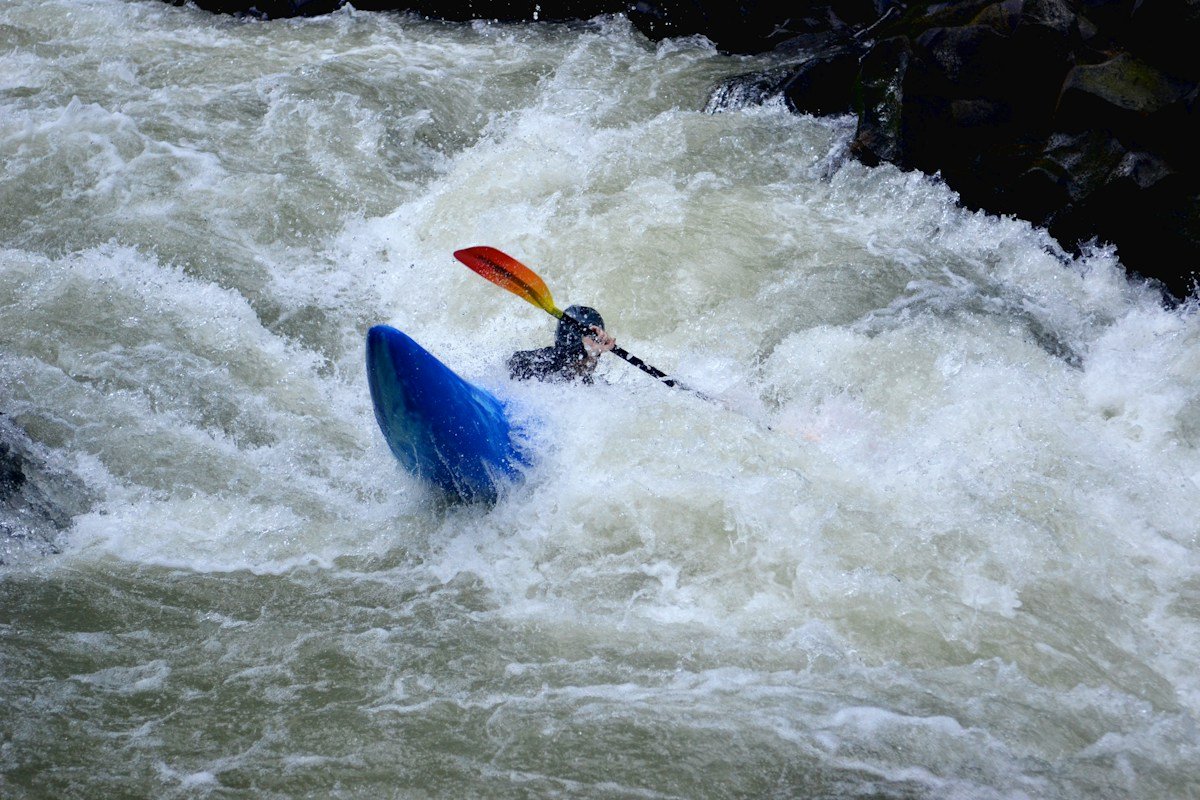

Solo whitewater river expeditions represent one of the most intense, unforgiving, and technically demanding disciplines in modern adventure exploration. Navigating a low-volume kayak, packraft, or specialized river craft through remote, roadless canyon gorges requires a total convergence of open-channel fluid mechanics, hydrological foresight, advanced whitewater boat control, and decisive swiftwater rescue engineering. In deep river canyons, where vertical granite walls plunge directly into roaring torrents and road access is nonexistent for scores of miles, the river functions as an unyielding one-way conveyor. There is no turning back against the current; every drop, constriction, and rapid must be successfully negotiated or portaged through sheer physical fortitude.
Unlike group expeditions where multiple boaters establish safety cover, set up downstream throw-bag stations, and provide immediate rescue support during swims, a solo expeditioner operates with zero physical margin for operational error. A single misplaced paddle stroke, an uncorrected broach against a midstream boulder, or a failed combat roll in a turbulent hydraulic hole can pin a boat underwater, break critical equipment, or leave the paddler swimming defenseless through continuous Class IV or V rapids. In this isolated high-stakes arena, safety is not passive; it is an active, calculated discipline rooted in deep hydrodynamic literacy and uncompromising self-rescue competence.
Executing a solo wilderness river descent demands exhaustive comprehension of river features: reading complex laminar and turbulent velocity vectors, calculating hydraulic backwash forces in recirculating pour-overs, recognizing lethal submerged siphons and strainers, and timing clean boof strokes across vertical drops. Furthermore, solo expedition logistics require meticulous weight distribution, multi-layered waterproof containment, field mechanical-advantage rigging for pinned craft extraction, and strict mental discipline to manage cognitive fatigue and avoid ego-driven decisions.
This operational technical manual delivers an authoritative, evidence-based blueprint for planning, navigating, and executing solo whitewater river expeditions. By integrating advanced fluvial geomorphology with certified swiftwater rescue methodologies and wilderness expedition logistics, it establishes the master standard for paddling self-sufficiency in the world’s most challenging river wildernesses.
Fluvial Geomorphology and Open-Channel Hydrodynamics
The physical behavior of a whitewater river is governed by open-channel fluid dynamics, gravitational potential energy, and riverbed geomorphology. As water flows downslope from mountain headwaters to sea level, its kinetic energy and velocity are determined by the channel gradient (measured in meters per kilometer or feet per mile), volumetric discharge (measured in cubic meters or cubic feet per second, CFS), and the roughness coefficient of the riverbed as modeled by Manning’s formula.
In high-gradient river canyons exceeding twenty to fifty meters of drop per kilometer, water velocity accelerates violently, transitioning from smooth laminar flow into chaotic turbulent flow. In turbulent regimes, internal friction between water molecules and rough riverbed boulders creates complex three-dimensional flow structures: vertical shear lines, bottom friction deceleration zones, surface acceleration tongues, and localized reverse currents. Water velocity is never uniform across a river cross-section; due to frictional drag against riverbanks and bottom substrate, the fastest water velocity concentrates in the upper-middle third of the channel, known as the thalweg.
Around river bends, centrifugal forces push the primary water volume and maximum surface velocity toward the outside bank, carving deep pools and undercutting bedrock walls, while the slower water on the inside bend deposits gravel bars. Solo paddlers must anticipate this centrifugal displacement: charging down the center of an outside bend frequently sweeps boaters directly into dangerous overhanging vegetation, undercut bluffs, or pinned logjams, requiring deliberate line positioning along the inside-to-middle flow vectors.
Furthermore, seasonal hydrologic pulses alter rapid dynamics completely. A boulder garden that provides technical, low-volume maneuvering at 500 CFS can transform into an unrecognizable monster of massive chaotic waves, boiling eddy fences, and crushing hydraulic holes at 5,000 CFS spring snowmelt discharge. Navigators consult real-time stream gauges maintained by hydrological agencies, tracking hydrograph curves to time expeditions during stable, manageable discharge windows.
Cold-Water Immersion Physiology and Acute Hypothermia Defense
Whitewater river canyons are among the most thermally aggressive aquatic environments on Earth. Fed by high-altitude glacial snowmelt and cold subterranean springs, remote rivers routinely maintain water temperatures between two and eight degrees Celsius (thirty-five to forty-six degrees Fahrenheit). At these temperatures, water strips heat from the human body twenty-five times faster than ambient air, creating an immediate biological threat the moment a boater capsizes.
Sudden immersion triggers the involuntary gasp reflex and acute cold shock response. Cold thermoreceptors in the skin cause immediate cutaneous vasoconstriction, driving blood pressure upward and forcing the heart into rapid tachycardia. If the paddler’s face is submerged during this initial gasping phase, water is aspirated directly into the trachea, triggering instant laryngospasm and drowning. The solo boater must consciously suppress this panic reflex, clamping their mouth closed and relying on their nose clip and helmet brim until establishing their roll setup.
During prolonged swims, cold incapacitation develops within seven to ten minutes. The cold water cools deep motor nerves in the forearms and calves, causing neuromuscular transmission failure. Fingers lose the ability to grasp throw lines, pull spraydeck release loops, or scramble up slick riverbank rocks. Even if wearing a high-flotation PFD, the swimmer eventually loses the ability to keep their airways clear of breaking wave chop. Solo expeditioners eliminate this danger by wearing heavy-duty breathable drysuits with sealed latex gaskets, layering thick synthetic fleece thermal suits beneath to maintain warm, dry internal microclimates across multiple swims.
International Scale of River Difficulty: Class I to Class VI Rapid Classification
To establish universal communication and risk assessment across global river systems, the whitewater community adheres to the International Scale of River Difficulty. Formalized by the American Whitewater association, this six-tier classification system standardizes rapid assessment based on technical difficulty, physical danger, scoutability, and the consequences of a failed run.
Class I represents fast-moving water with small ripples and clear channels requiring minimal maneuvering. Class II features wide, clear channels with medium-sized waves, straightforward rapids, and easily avoidable obstacles. Class III rapids exhibit moderate, irregular waves capable of swamping open canoes, complex maneuvering around boulders, strong eddy currents, and clear passage routes visible from the boat. Swims in Class III are generally non-life-threatening, though self-rescue is required to avoid foot entrapment.
Class IV marks the critical threshold where rapids become intense, powerful, and hazardous. Rapids feature turbulent wave trains, constricted passages, dangerous recirculating holes, and unavoidable boiling eddy lines demanding precise boat handling under physical pressure. Scouting from shore is typically necessary to identify the line, and a swim in Class IV carries severe risks of injury, equipment loss, and prolonged immersion trauma.
Class V represents extreme, violent whitewater where drops are long, congested, and highly technical. Hydraulic features are violent and unforgiving, routes are intricate and difficult to scout, and mistakes carry catastrophic consequences, including boat pinning, entrapment, and fatal drowning. Class VI represents the unrunnable boundary: rapids possessing extreme hazard profiles where routes are unpredictable, water energy is lethal, and rescue is statistically impossible. Solo expeditioners strictly avoid Class VI and treat Class V with extreme tactical conservatism, reserving runs exclusively for scouted, low-risk conditions.
River Hydraulic Anatomy: Eddies, Waves, Holes, and Siphons
Navigating whitewater safely requires dissecting the anatomy of individual river hydraulics. Every rapid is a mosaic of discrete physical features created when high-velocity water interacts with stationary riverbed geology.
An eddy is a calm or reverse-flow sanctuary formed directly behind an exposed midstream boulder or protruding riverbank. As water flows around the obstacle, a void is created downstream; water rushes backward into this low-pressure void from downstream, creating an upstream-flowing pool. The boundary separating downstream current from the upstream-flowing eddy is the eddy line, a shear zone characterized by turbulent boils, whirlpools, and sudden differential friction. Crossing an eddy line requires edging the boat hull into the turn and executing a crisp eddy turn or peel out to prevent the shear current from catching the upstream gunwale and flipping the craft.
Standing waves (wave trains) form when fast water decelerates over deep obstacles or converges in downstream V-tongues. These smooth, rhythmic waves provide exhilarating forward passage. However, when water pours over a submerged ledge or rock shelf, it drops steeply and plunges into a deep basin before surging back upstream toward the drop, forming a hydraulic hole (or stopper). The upstream-flowing surface water, termed the backwash, recirculates continuously. In mild holes, the aerated foaming backwash washes harmlessly over the boat; in steep, smile-shaped keeper holes where the backwash extends from bank to bank, the hydraulic forms a recirculating trap that can hold a kayak and swimmer indefinitely, tumbling them underwater in a continuous washing-machine cycle.
Subsurface geological traps represent the deadliest objective hazards in whitewater. A strainer is an obstruction (such as a fallen tree or brush pile) that allows water to pass freely while catching and pinning solid objects (kayaks and humans) against the wood under massive hydraulic pressure. An undercut rock is a boulder whose subsurface base has been hollowed out by hydraulic erosion; water flows beneath the rock ledge, creating a suction trap that pulls swimmers beneath the surface. A siphon is an underwater passage between jammed boulders through which river water rushes under high pressure; swimming into a siphon results in immediate mechanical entrapment and drowning.
Kayak and Expedition Craft Naval Dynamics: Hull Design and Volume Distribution
The physical design of an expedition whitewater craft directly dictates its maneuverability, primary stability, and recovery characteristics in turbulent hydraulics. In modern whitewater kayaking, hull designs are categorized into creek boats, river runners, and packrafts.
Creek boats are the undisputed standard for steep, technical, and remote expeditions. Engineered with displacement or semi-displacement rounded hulls and massive bow and stern volume (typically 300 to 380 liters), creek boats resurface instantly after vertical drops and punch effortlessly through heavy hydraulic holes. The high-volume deck profile resists being sucked underwater by boiling eddy lines. Modern creek designs incorporate aggressive progressive bow rocker, an upward curvature that lifts the bow over oncoming waves and allows the paddler to boof off ledge drops, landing flat on the downstream current rather than plunging deep into recirculating hydraulic holes.
River-runner and half-slice designs feature flatter planing hulls with sharp edges (chines) and lower stern volume. While these boats carve dynamic, high-speed surf turns on wave faces, their low-volume sterns are easily grabbed by strong eddy lines and backwash currents, making them significantly more fatiguing and hazardous for heavy solo expeditions loaded with camping gear.
Packrafts, constructed from ultra-durable thermoplastic polyurethane (TPU) coated nylon fabrics, have revolutionized remote wilderness river exploration due to their ultralight weight (three to five kilograms). However, their wide inflatable tubes and lack of rigid hull chines introduce high hydrodynamic drag and lower hull speed. Modern expedition packrafts incorporate internal cargo-fly zipper systems that allow gear to be stowed directly inside the airtight hull tubes, lowering the center of gravity and providing remarkable secondary stability in Class III and IV whitewater.
Scouting and Running Complex Whitewater: Visual Line Selection and Boofing
The hallmark of an expert solo river runner is meticulous scouting and disciplined line selection. When approaching an unmapped rapid whose downstream horizon disappears over a drop, the solo paddler must never run blind. The paddler catches an upstream eddy, pulls the boat completely onto the bank, and hikes down the shoreline to scout the rapid from an elevated vantage point.
Scouting begins from the bottom of the rapid and works backward upstream. The paddler identifies the exit gate, safe runout zones, and recovery eddies at the bottom of the rapid first, ensuring that a swim will not sweep into downstream death traps. Next, the paddler examines midstream obstacles, identifying keeper holes, undercut boulders, and critical must-make moves. Finally, the paddler traces the entry tongue: a smooth, glossy downstream V-point of green water indicating the deepest, cleanest channel between exposed riverbed rocks.
Executing technical drops requires mastering the boof stroke. When paddling over a river ledge, waterfall, or steep rock drop, allowing the kayak’s bow to dive straight down plunges the boat deep into the turbulent hydraulic hole at the base, resulting in violent back-enders and pins. To execute a boof, the paddler accelerates toward the lip of the drop, reaches forward, and plants an aggressive, powerful vertical forward stroke directly at the edge of the ledge. As the blade catches, the paddler snaps their hips forward and pulls their knees toward their chest, launching the kayak horizontally through the air.
The boof keeps the bow high and dry, allowing the flat hull to land squarely across the aerated downstream boil line, skipping over the recirculating backwash and maintaining instantaneous forward velocity. In solo expeditioning, a consistent, powerful boof is the single most valuable technical weapon for clearing dangerous ledge holes cleanly without taking punishing impacts.
Swiftwater Self-Rescue Mechanics: Defensive vs Aggressive Swimming
When an accidental wet exit occurs during a solo descent, the paddler instantly transitions from boat pilot to swiftwater swimmer. Surviving a swim in turbulent whitewater requires automated, disciplined swimming biomechanics designed to navigate rocky channels and avoid fatal foot entrapment.
The foundational rule of whitewater swimming is absolute: NEVER stand up in fast-moving water deeper than mid-calf. If a swimmer drops their feet to the riverbed while water rushes past at six to ten kilometers per hour, the current wedges the foot into a rock crevice, known as foot entrapment. The overwhelming hydraulic force of moving water pushes the swimmer forward from behind, forcing their torso underwater and holding them pinned face-down under immense pressure, resulting in rapid drowning even in shallow rapids.
The primary default posture is defensive swimming. The swimmer rolls onto their back, floating with their head pointed upstream and their feet pointed downstream. Knees are slightly bent, and toes are kept pointed above the water surface, functioning as shock absorbers to bounce off submerged rocks. The arms scull laterally at waist level to steer across currents and navigate around obstacles, while the personal flotation device (PFD) keeps the head and airways clear of breaking waves.
When approaching a safe shoreline eddy, a calm gravel bar, or an unavoidable strainer hazard, the swimmer transitions instantly to aggressive swimming. The swimmer rolls onto their stomach, lifts their head above wave chop, and charges diagonally across the current using an explosive freestyle crawl stroke. When crossing an eddy line, the swimmer punches through the turbulent shear boil and drives deep into the calm eddy pool, scrambling onto the riverbank to exit the aquatic environment.
If swept toward an unavoidable tree strainer across the channel, defensive back-swimming is lethal, as the current pushes the swimmer beneath the log jam. The swimmer must flip onto their stomach, sprint directly toward the strainer with maximum acceleration, and execute an aggressive barrel roll over the top of the log, launching their torso and arms over the obstruction to avoid being pinned beneath the water.
Combat Roll Mechanics in Heavy Aerated Whitewater
In the extreme environment of Class IV and V whitewater, an accidental capsize is not an indicator of failure; it is an inevitable hydrodynamic consequence of running turbulent water. What distinguishes an elite whitewater expeditioner is the possession of an automated, instantaneous combat roll that functions reliably in aerated foam, boil lines, and crushing wave faces.
The physical dynamics of rolling in aerated whitewater diverge significantly from flatwater pool mechanics. Highly aerated white foam (water saturated with microscopic air bubbles) exhibits a specific gravity ranging from 0.5 to 0.7, compared to 1.0 for solid green water. This reduction in fluid density dramatically decreases the buoyant lift and hydrodynamic purchase generated by a sweeping paddle blade. If a paddler attempts to execute a flatwater sweep roll on the surface of white foam, the paddle blade slices through the bubbles without resistance, causing the roll to fail.
To roll in aerated whitewater, the paddler must reach deep beneath the foam into the dense, solid green water beneath the surface aerated layer. The paddler sets up in a tight forward tuck against the front deck, protecting their face from submerged rocks. The blade is swept outward and downward into solid water, providing a solid fulcrum. Simultaneously, the paddler executes a violent, explosive hip snap, driving their lower knee upward against the thigh brace to rotate the hull 180 degrees beneath them while keeping their head low and in the water until the kayak is completely upright.
Psychological composure is the primary foundation of the combat roll. Under violent capsizes, cold water shock and sensory disorientation create a panic reflex that tempts boaters to pull their spraydeck release loop prematurely. The solo expeditioner must cultivate an unwavering mental rule: attempt a minimum of three distinct, disciplined rolls (adjusting blade depth and timing between wave cycles) before ever considering a wet exit, as swimming in high-gradient whitewater is exponentially more dangerous than remaining locked within the protective hull of a creek boat.
Swiftwater Entrapment Extraction: Cinches, Snags, and Tensioned Diagonals
When a boat or equipment becomes submerged and jammed deep within a boulder sieve or rock crevice, simple linear pulling lines often prove completely ineffective against pinning hydraulics. Swiftwater rescue practitioners deploy advanced rope cinch systems to capture and dislodge submerged hulls.
The Carlson Cinch and the Continuous Loop Cinch are the premier mechanical configurations for snaring submerged craft. By floating a weighted rope loop across the river and maneuvering it from both shorelines, rescuers slip the loop over the exposed bow or stern grab loop of the pinned kayak. Once seated, pulling the running end cinches the loop with tremendous mechanical friction, establishing an unbreakable connection to the pinned craft without requiring a rescuer to swim into hazardous pinning hydraulics.
In deep canyons where crossing the river or moving equipment across vertical gorges is necessary, solo expeditioners rig tensioned diagonals. Anchored high on an upstream rock face and tensioned across the current to a downstream anchor on the opposite bank, the tensioned high-strength Dyneema line utilizes river current energy to ferry gear and packrafts across boiling torrents using low-friction traveler pulleys, establishing safe logistics across impassable river chasms.
Solo River Psychology, Heuristic Traps, and the Portage Mandate
The psychological landscape of a solo whitewater river expedition is defined by acute cognitive pressure. Operating alone in a roadless river gorge eliminates the safety cushion provided by companion boaters, amplifying every objective risk. Under these conditions, human decision-making becomes vulnerable to well-documented heuristic traps that lead directly to catastrophic river accidents.
The most dangerous psychological trap is commitment bias, compounded by physical exhaustion. When an expeditioner approaches a blind, roaring Class V canyon gorge in late afternoon after eight hours of grueling paddling, the physical prospect of carrying a heavy, fully loaded kayak over slippery, boulder-choked canyon cliffs (a grueling portage) feels agonizing. The paddler experiences a subconscious temptation to talk themselves into running the rapid, downplaying visible hydraulic traps and rationalizing the run to avoid physical labor. In solo paddling, yielding to this temptation is frequently fatal.
To counteract cognitive heuristics, expert solo expeditioners enforce the portage mandate: if there is any doubt regarding the safety of a line, or if a single hydraulic feature presents an unacceptable probability of pinning or swimming, the rapid is portaged immediately without debate. Portaging is not a concession of weakness; it is the ultimate expression of professional wilderness judgment, ensuring that the expeditioner survives to complete the journey and explore future rivers.
Solo Mechanical Advantage Rigging and Pinned Craft Extraction
A pinned kayak represents an immediate existential crisis on a solo expedition. When a boat broaches broadside against a midstream rock, hydraulic pressure builds exponentially against the hull. At water velocities of fifteen kilometers per hour, the force exerted by flowing water against a swamped kayak hull exceeds 1,500 to 2,000 kilograms (three to four tons), wrapping polyethylene plastic hulls tightly around boulders like wet paper.
Extracting a pinned boat without companion assistance requires specialized swiftwater mechanical-advantage rigging. A solo expeditioner carries a dedicated pin kit in their PFD: thirty meters of ultra-high-molecular-weight polyethylene (Dyneema or Spectra) floating line, two prusik loops, three high-efficiency rescue pulleys, four locking carabiners, and tubular webbing anchor slings.
The standard mechanical setup is the 3:1 Z-drag system. The explorer establishes a bombproof anchor on a living hardwood tree or bedrock horn on shore. A primary pull line is secured to the pinned kayak’s grab loop. A directional pulley is attached to the tree anchor. A traveling pulley is attached to the loaded line using a three-wrap prusik hitch. When the explorer hauls on the free line, the system multiplies human pulling force three-fold (yielding roughly 150 to 200 kilograms of pulling force from a single person), breaking the hydraulic seal holding the kayak.
If additional mechanical force is required to peel a wrapped hull off a rock, the explorer compounds the system into a 5:1 complex drag by adding a secondary traveling pulley. Alternatively, applying a vector pull (pulling perpendicularly on the middle of a tensioned line) generates immense instantaneous lateral breakout force, dislodging the boat from the boulder pin and hauling it into a recovery eddy.
Personal Protective Equipment and Thermal Immersion Armor
Operating on remote whitewater rivers demands specialized personal protective equipment engineered to absorb violent kinetic impacts and prevent rapid cold-water incapacitation.
The personal flotation device is the non-negotiable life support foundation. Solo expeditioners wear certified Type V rescue PFDs providing a minimum of 70 to 100 Newtons (16 to 22 pounds) of inherent foam buoyancy. High-volume chest foam cushions the rib cage against rock impacts, while an integrated quick-release rescue chest harness fitted with a stainless steel friction cam and O-ring allows the paddler to tether themselves to safety lines with instantaneous release capability.
Head protection requires certified whitewater helmets constructed with impact-resistant carbon-Kevlar or ABS outer shells lined with closed-cell expanded polypropylene (EPP) multi-impact foam. Full-cut helmets extending over the ears and temple regions protect vulnerable cranial zones from underwater boulder strikes during capsizes and rolls.
Immersion protection is mandatory even in sunny weather. Snowmelt rivers maintain water temperatures between two and eight degrees Celsius (thirty-six to forty-six degrees Fahrenheit). A heavy-duty four-layer breathable membrane drysuit fitted with tough latex neck and wrist gaskets, reinforced Cordura seat and knee panels, and waterproof relief zippers provides total waterproof armor, keeping the paddler dry and thermally stable throughout continuous rolls and swims.
Wilderness River Camp Logistics and Watershed Conservation
Establishing an expedition camp in deep river canyons requires acute awareness of flash flooding. Canyon river levels can fluctuate wildly overnight due to upstream tributary storms, dam releases, or rapid snowmelt surges. Expeditions must pitch base camps well above the high-water line, marked on canyon walls by the flood line of bleached driftwood and scour lines.
Boats must be hauled completely clear of the riverbed and tied off to bedrock boulders with heavy painter lines. Gear stowed inside kayaks must be compartmentalized in heavy polyurethane drybags, utilizing dual-roll closures and purge valves to compress volume while ensuring absolute watertight integrity.
Field hull repair is an essential river craft discipline. Solo expeditioners carry specialized emergency repair kits containing aluminum duct tape, multi-purpose polyurethane adhesives (such as Aquaseal), miniature blowtorches, and scraps of high-density polyethylene plastic. If a plastic creek boat hull cracks against a sharp granite boulder in remote canyons, the boater cleans the fracture, drills small relief holes at both ends of the crack to halt propagation, and welds plastic donor shavings across the seam using the torch to restore watertight integrity.
Satellite communications in narrow river canyons present unique physical challenges. Sheer vertical canyon walls (such as those in the Grand Canyon or Black Canyon of the Gunnison) block line-of-sight view to geostationary communication satellites, leaving only narrow windows directly overhead. Solo expeditioners carry dual satellite messengers (such as Garmin inReach or ZOLEO devices operating on the low-Earth-orbit Iridium satellite constellation). The boater must track satellite pass windows, positioning communicators on elevated rock promontories to transmit daily check-in pings and receive weather updates.
River wilderness conservation operates under strict Leave No Trace river ethics. River corridors are fragile, high-traffic riparian ecosystems where human waste decomposes extremely slowly. Solo expeditioners carry approved solid human waste containment systems (groover tubes or wag bags), packing out all solid waste and toilet paper. Campfires must be contained within elevated fire pans to prevent charcoal contamination of pristine canyon sandbars.
To establish rigorous institutional standards for whitewater expedition planning across varying hydrological environments, river guides and swiftwater rescue instructors rely on comprehensive diagnostic matrices. These operational frameworks evaluate rapid difficulty tiers, dominant hydraulic hazards, mandatory craft specifications, scouting protocols, and rescue extraction complexity.
The following diagnostic matrix provides a comparative operational reference evaluating primary whitewater rapid classifications, dominant hydraulic traps, required boat designs, navigational scouting demands, and swim hazard profiles.
Comparative Diagnostic Matrix of Whitewater Rapid Classes and River Hydraulics
| Rapid Classification | Hydraulic Features & Fluid Forces | Mandatory Craft & Gear Architecture | Scouting & Navigational Demands | Swim & Entrapment Hazard Profile |
|---|---|---|---|---|
| Class II: Novice Flow | Wide channels, regular standing waves under 1m, clear downstream V-tongues, mild eddies | Standard river kayak or open packraft, neoprene spraydeck, basic PFD, drainage bailer | Boat scouting only; visible lines from water; minimal route planning required | Low; defensive back-swimming reaches shore easily; foot entrapment avoidance |
| Class III: Intermediate Rapids | Irregular 1-2m wave trains, moderate hole stoppers, powerful eddy fences, boulder maneuvering | River-runner or creek boat, Type V PFD, full-cut helmet, drytop or drysuit | Occasional bank scouting; distinct entry tongues; multiple alternative recovery eddies | Moderate; swims require aggressive crawl to eddies; gear recovery may require swim aid |
| Class IV: Advanced Whitewater | Constricted canyon chutes, powerful keeper holes, boiling whirlpools, unavoidable wave obstacles | High-volume creek boat, full drysuit, rescue harness PFD, 3:1 pin kit, Dyneema line | Mandatory bank scouting; complex must-make micro-moves; single tight run lines | High; severe injury risk from boulder impact; long turbulent swims; hole recirculation |
| Class V: Expert Gorges | Violent drops, terminal ledge holes, continuous turbulence, siphons, undercut walls | Creek boat with maximum bow rocker, carbon helmet, drysuit, dual pin kits, satellite SOS | Extensive multi-angle bank scouting; portage evaluation; high-precision boof timing | Extreme; swims frequently fatal or incapacitating; vertical canyon prevents self-rescue |
| Class VI: Unrunnable Boundary | Lethal chaotic waterfalls, total channel blockage, massive siphons, unmanageable volume | Portage harness, technical climbing ropes, mechanical descenders, hauling anchors | Scouted strictly to identify portage routes and cliff descent pathways around drop | Total; rescue impossible; lethal consequences on all lines; unrunnable by standard |
Mastering these fluvial dynamics and safety frameworks enables solo river explorers to navigate wild aquatic canyons with exceptional technical competence and safety. For authoritative data on river levels, hydrologic monitoring, and whitewater safety protocols, paddlers consult reputable institutions including American Whitewater River Safety Archives and the United States Geological Survey National Water Information System. Professional swiftwater rescue curricula can be reviewed via Rescue 3 International Swiftwater Training, while global paddling guidelines are curated by the International Rafting Federation Safety Committee and British Canoeing White Water Technical Group.
Frequently Asked Questions About Whitewater River Expeditions
What causes foot entrapment in fast-moving whitewater?
Foot entrapment occurs when a swimmer attempts to stand up in fast-moving water deeper than mid-calf. The swimmer’s foot slides into a rock crevice or boulder notch on the riverbed, and the overwhelming force of the downstream current pushes the swimmer forward, pinning them face-down underwater where drowning occurs within minutes.
What is the difference between a downstream V and an upstream V?
A downstream V points downstream, indicating a deep, clear water tongue pouring smoothly between two submerged rocks, representing the primary line of travel. An upstream V points upstream, formed when water splits and piles up against an exposed rock obstacle, indicating a hazard that must be avoided.
How does a boof stroke prevent kayak pins on ledge drops?
A boof stroke is planted right at the lip of a vertical ledge drop accompanied by an aggressive hip snap. This lifts the kayak’s bow horizontally into the air, allowing the flat hull to land squarely across the aerated boil line below rather than plunging nose-first into recirculating keeper holes.
What is a hydraulic keeper hole in whitewater river hydrology?
A keeper hole is formed when water pours over a submerged ledge, plunges into a depression, and recirculates back upstream toward the drop. If the aerated backwash is steep and continuous across the channel, it forms a powerful recirculating trap that holds kayaks and swimmers indefinitely.
How does defensive swimming protect whitewater boaters during a swim?
Defensive swimming positions the swimmer on their back, floating with feet pointed downstream and toes up at the surface. Knees remain slightly bent to absorb boulder impacts, while the arms scull laterally to steer. This posture keeps the face clear of waves while preventing foot entrapment.
What is a 3:1 Z-drag system used for in river rescue?
A 3:1 Z-drag is a mechanical-advantage rope rigging system utilizing traveling pulleys and prusik hitches anchored to shore. It triples the pulling force exerted by a rescuer, allowing a solo expeditioner to exert hundreds of kilograms of mechanical force to peel a swamped or pinned kayak off riverbed boulders.
What makes a creek boat ideal for remote solo river expeditions?
Creek boats feature massive bow and stern volume (300 to 380 liters), rounded displacement hulls, and aggressive progressive bow rocker. This naval geometry allows the boat to resurface instantly after vertical drops, skip across heavy holes, and provide high secondary stability in boiling eddy lines.
What danger does an undercut rock present to swimmers?
An undercut rock has had its underwater base eroded away by hydraulic currents, creating an overhang beneath the surface. Water flows directly beneath the rock ledge, creating powerful downward suction that draws swimmers and boats under the rock where entrapment occurs.
How should a swimmer respond when swept toward an unavoidable tree strainer?
When approaching a tree strainer, defensive back-swimming is fatal because the current pins the swimmer beneath the branches. The swimmer must flip onto their stomach, sprint aggressively toward the tree with maximum freestyle speed, and execute a dynamic barrel roll over the top of the log.
Whitewater River Expedition Synthesis and Fluvial Legacy
Solo whitewater river exploration represents the pinnacle of aquatic autonomy and focused athletic engagement with nature. By riding the kinetic pulses of planetary waterways with disciplined hydrodynamic science, unyielding self-rescue competence, and profound environmental humility, the solo paddler transforms turbulent river canyons into extraordinary corridors of discovery. In the roaring heart of the rapid, where fluid physics and human willpower intersect, river exploration reaffirms our enduring human capacity to navigate the wildest frontiers of planet Earth.