
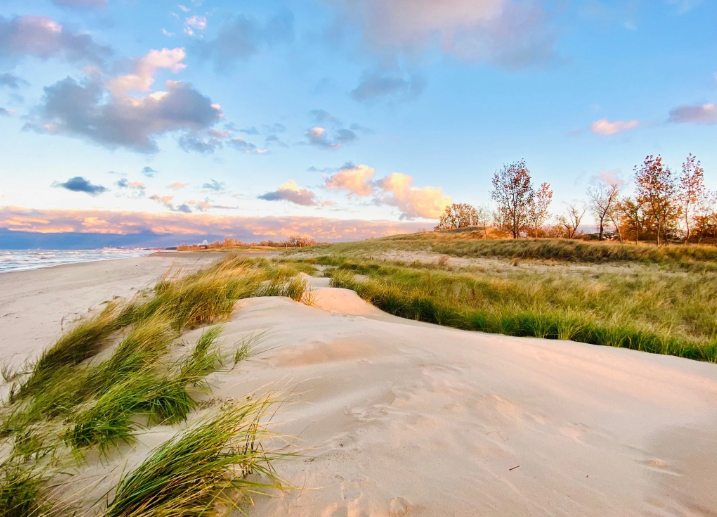

Today, we are visiting the Indiana Dunes. These sand dunes are located near Chicago, Illinois. They rise from the shores of Lake Michigan, one of the five Great Lakes of America.
More than two million people visit the dunes in the Midwestern state of Indiana each year. The winds along Lake Michigan created some of these dunes in ancient times. Others may be forming right now. Winds create dunes when they deposit loose sand on land. Some dunes are partly round. Others take the form of long, narrow hills.
Visitors from all over the world come to explore the area near the dunes. They swim and sail on the lake. They observe birds in the wetlands. They study the rich oak and maple forests and their plant life. The smooth sands of the dunes and lakeshore produce a clear, musical sound when walked on. Some of these sounds can be heard from up to ten metres away. Visitors often say that the sand dunes ‘sing’.
The state and federal governments of Indiana control more than six thousand hectares of land along the lake. They operate visitor areas and scientific research stations in the parks. Supervision by these agencies ensures that the land will always remain publicly accessible. Laws protect the plants, animals and natural and historical features of interest.
During the 20th century, many people worked hard to prevent the dunes being developed for industrial and port use. This was not easy. The land along that stretch of Lake Michigan is extremely valuable. Some of the land provides important ports for the lake. Industries and the Indiana Natural Gas Company also operate along the lake.
In the early 1950s, some companies were removing five tons of sand from the dunes each day. In 1952, scientists from the Indiana Geological Survey investigated the sand supply. They predicted that the dunes would disappear within fifty to one hundred years if companies continued to remove sand at that rate. The dunes were created by the wind and waves of Lake Michigan over thousands of years. Yet people could destroy them in a lifetime.
The federal government established the National Park Service in 1916. Stephen Mather, a Chicago businessman, was its first director. Mr Mather established many national parks. He wanted the Indiana Dunes to become a national park too. However, the United States had entered the First World War in 1917. Congress was not considering the creation of parks at that time. Its focus was on soldiers and military supplies.
Nevertheless, public support for a protected dunes park continued to grow. In 1923, Indiana passed a bill providing tax money to buy property along the lake from its private owners. The Indiana Dunes State Park opened in 1926. It covered more than eight hundred hectares of land.
Local citizens, scientists and visitors alike were pleased with the state park. But they were not satisfied. They wanted to see much more of the lakefront protected from development, including the construction of factories and industrial ports. Activist Dorothy Buell led the campaign for a national park in the dunes. She established the Save the Dunes Council in 1952.
The representatives of Indiana in the United States Senate opposed the proposed park. They argued that ports on the lake would create more job opportunities for local people than a national park would. However, the Save the Dunes Council found a powerful ally in the form of United States Senator Paul Douglas. He represented the neighbouring state of Illinois. Senator Douglas loved the dunes. Every year, he introduced a bill to establish an Indiana Dunes National Lakeshore. However, the bill failed to pass every year.
In 1966, those in favour of development finally reached a compromise with those in favour of a national park. First, Congress passed a bill to develop more ports. The bill also established the Indiana Dunes National Lakeshore. Further legislation added more land to the park. Today, the federal Indiana Dunes National Lakeshore covers more than six thousand hectares and also includes the Indiana Dunes State Park.
The Save the Dunes Council has been involved in many other battles. It has successfully fought off a number of threats. These include the use of vehicles in the park. Sand mining. An airport on the lake. , and the construction of a nuclear power centre near the park.
The council has also campaigned for tougher enforcement of air and water pollution control legislation in industrial areas near the park.
A modern federal road now follows the route of an old walking trail through the dunes known as the Beach Trail. Long ago, this trail was a route between two forts. The settlers built the forts to protect themselves from attacks by Native American tribes. These forts later became the cities of Chicago, Illinois and Detroit, Michigan.
In 1822, a trader from Michigan settled in the Indiana Dunes. Joseph Bailly opened a store and raised a family near Lake Michigan. He exchanged warm blankets and guns for animal furs supplied by Native Americans and travellers.
At first, Mr Bailly and his family lived in a small wooden house. The trader was building a larger house when he passed away. The National Park Service has restored the exterior of this large white house.
Later, a student from the University of Chicago brought scientific knowledge to the dunes. Henry Chandler Cowles received funding from the university to study landforms and plant fossils from a time when much of the world was covered by ice. In 1896, Mr Cowles decided that the Indiana dunes would be an excellent place for his research.
His studies showed how plant communities could bring about significant changes to the landscape. He demonstrated how groups of plants could create the conditions necessary for a sand dune to become a living forest. He went on to become a renowned professor and researcher. His work in the Indiana Dunes helped to spread the science of ecology throughout the world.
Other scientists have explained how the sand hills formed. They say that a huge, thick river of ice helped to create the Indiana dunes. Thousands of years ago, this glacier moved over what is now central Indiana. As it moved, the heavy ice crushed the rocks into tiny pieces. Over time, part of the glacier formed a body of water known as Lake Chicago, an early version of Lake Michigan. As the glacier melted, it dropped the sand it had created around the lake. The sands of present-day Lake Michigan are constantly in motion. Winds and waves carry sand from the lake to the surrounding land.
Strong winds lift the sand and drop it on the land below. This process begins to build new dunes.
Over time, plant life develops on these sand hills. The cottonwood tree, for example, is usually the first to grow on a new dune. Then, the winds dig a hole in the sand. They use the loose sand from this hole to create a large, moving dune. Such a dune can damage or destroy anything in its path. However, cottonwood trees can help. As the sand buries them, the trees grow roots along their trunks. These roots help to stabilise the dune.
One such dune, Mount Baldy, guards the northern end of the Indiana Dunes National Lakeshore. Beautiful trees encircle its lower slopes. Thousands of people climb the thirty-eight metres to the top of Mount Baldy each year. But getting there can be difficult. Climbers often find that their footsteps on the steep sandy slope cause them to slide back down again.
Locals tell stories about a mysterious woman who once lived in a small house not far from Mount Baldy. Alice Marble Gray moved to the Dunes from Chicago at the age of thirty-five. She shocked people by swimming in Lake Michigan without a swimsuit. Fishermen compared her to the Roman goddess Diana. Thus began the traditional story of Diana of the Dunes.
According to this legend, Diana fell in love with a man who treated her badly. She died in 1925. Health officials said that evidence of beatings was visible on her body. Over the years, people have claimed to see her swimming in the lake at night. In the moonlight, they say, you can still see her running along the sands of the Indiana Dunes.