
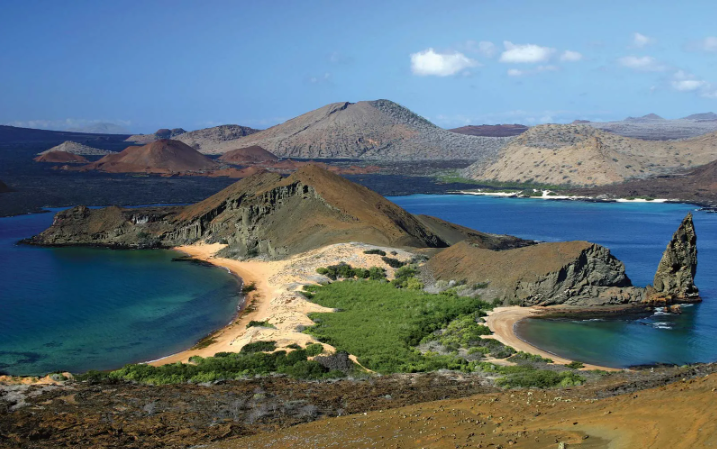

Today, we will be talking about the Galapagos Islands in the Pacific Ocean and the unusual creatures that inhabit them.
The nineteen islands that make up the archipelago lie along the equator, one thousand kilometres west of Ecuador. They are named after the giant tortoises that inhabit them. The Galapagos Islands have been called “a living museum and showcase of evolution”. The animals on the islands inspired British naturalist Charles Darwin’s theory of evolution by natural selection.
In 1978, the islands became the first place to be added to the World Heritage List by UNESCO. In 2007, UNESCO added the islands to its World Heritage in Danger list. The main reason for this is the increase in visitor numbers.
The World Heritage Committee stated that increased tourism, immigration, and invasive species pose a threat to the animals of the Galapagos. Many of these animals are found nowhere else in the world. The committee noted that the number of days passengers have spent on ships in the area has increased by 150% in the last 15 years. Last year, more than 170,000 people visited the islands.
Increased tourism has brought thousands of Ecuadorian workers to the islands in search of employment. Some of these workers have introduced non-native species such as dogs, cats, pigs and goats. These animals compete with the islands’ native species for food. Some also attack native species. The waste produced by the growing human population also poses an increased threat to wildlife.
The Ecuadorian government has tried to enforce severe limits on the number of Ecuadorians moving to the islands. However, many Ecuadorians have criticised these efforts. They believe that they have the right to live on the islands and improve their standard of living.
A new report in the journal Global Change Biology states that the Galapagos Islands’ ecosystem has been permanently altered. This destruction is due to human activity, as well as rising sea temperatures and overfishing.
The researchers who wrote the report say that at least forty-five species are now under extreme threat. They also say that it is likely that two species have disappeared forever. These are the Galapagos damselfish and the twenty-four-rayed sunstar.
The Galapagos Islands have always been shrouded in mystery. In 1535, a ship carrying the Roman Catholic Bishop of Panama came upon the islands by accident. Tomas de Berlanga named the group of islands the Enchanted Isles. He was amazed to find land turtles weighing more than two hundred kilograms and measuring over one metre in length.
He said that each one could carry a man on its back. Bishop Berlanga also noted the islands’ unusual soil. He remarked that one island was so rocky that it seemed as if stones had rained from the sky.
Ecuador officially took possession of the islands in 1832. It was the British naturalist Charles Darwin who made the Galapagos Islands famous. He visited them in 1835. He collected plants and animals from several of the islands. After many years of research, he published the book ‘On the Origin of Species’ in 1859. In it, he set out his theory of evolution, which states that life on Earth developed through the process of natural selection.
This book changed the way people think about how living things have developed and changed over time. Darwin said that the Galapagos brought people “near to that great fact — that mystery of mysteries — the first appearance of new beings on Earth”.
One hundred years later, in 1959, the Ecuadorian government designated almost all of the islands as a national park. The same year, the Charles Darwin Foundation was formed to study and protect the islands’ flora and fauna.
There are more than 125 landmasses in the Galapagos. However, only nineteen of these are large enough to be considered islands. For years, scientists have wondered about the location of the Galapagos in the Pacific Ocean. They used to think that the islands were once connected to the South American mainland and slowly floated out to sea.
Today, however, most scientists believe that the islands have always been where they are now. However, they believe that the islands were once a single underwater landmass. Over time, volcanic activity broke the large island into pieces that rose to the surface of the sea.
However, scientists are wondering how animals arrived on the Galapagos Islands if they were always so far from the mainland. They think that most Galapagos plants and animals floated to the islands. When South American rivers flood, small pieces of land flow into the ocean. These rafts can carry trees and bushes. They can also hold small mammals and reptiles. Adult Galapagos tortoises are clearly too big for a journey of hundreds of kilometres across the ocean. However, turtle eggs or baby turtles would be small enough to float there.
The Galapagos Islands are home to many unusual species of bird, reptile and small mammal. Some of these animals live nowhere else on Earth. The tortoise is the most famous reptile in the Galapagos Islands. However, the marine iguana is also unique. It is the only iguana in the world that enters the ocean. It can dive at least fifteen metres below the surface of the ocean. It can also stay underwater for more than thirty minutes.
In 2009, scientists confirmed the discovery of a new species of iguana. This pink iguana is believed to be an older form of the species than the other iguanas found on the islands. This newly discovered iguana has a pink head and black stripes on its body.
Several unusual birds also live on the Galapagos Islands. One of these is the only penguin species that lives at the equator. Another is the frigatebird. It has loose skin on its throat which it can inflate to create a large, red, balloon-like structure. It does this to attract females, which make observation flights over large groups of males.
The Galapagos are also noted for a bird that prefers water to land or air. Cormorants are able to fly in all the other places they live around the world. However, the Galapagos cormorant has extremely short wings. They cannot support flight. However, they are ideal for swimming.
The islands are also home to a variety of small birds known as Darwin’s finches. Charles Darwin studied these birds carefully when he visited the Galapagos in 1835. He categorised the birds according to the shape of their beaks. He discovered that finches living in different places and eating different foods had different-shaped beaks.
However, the most famous animals on the Galapagos Islands are the thousands of giant tortoises. The most famous of these is Lonesome George, as he is the last of his kind.
He has been described as the rarest creature on Earth. At one time, the islands were home to around fifteen species of land turtle. The largest island, Isabela, is home to five species of tortoise. However, Lonesome George is not one of them. He hails from a smaller island called Pinta.
Scientists discovered him in 1971. The environment on his island had been badly damaged by humans and non-native animals. Some animals and plants had disappeared. Lonesome George was the only tortoise found on Pinta.
The tortoise was taken to the Charles Darwin Research Centre on Santa Cruz Island. Their aim was to help him find a female tortoise with which to mate and produce baby tortoises. They had been successful in similar efforts with thousands of other tortoises.
They placed George in the same enclosure as females from the nearby island of Isabela. They thought he would be more closely related to them than to other Galapagos tortoises. In 2008, George surprised the scientists by mating for the first time in 36 years.
The eggs were taken to a laboratory where they could be protected and closely observed. Unfortunately, the eggs were later found to be infertile. However, new eggs appeared in two nests over the past year. Despite being between ninety and one hundred years old, George may still become a father. There is therefore still hope that, in the near future, George will no longer be quite so ‘lonesome’.