
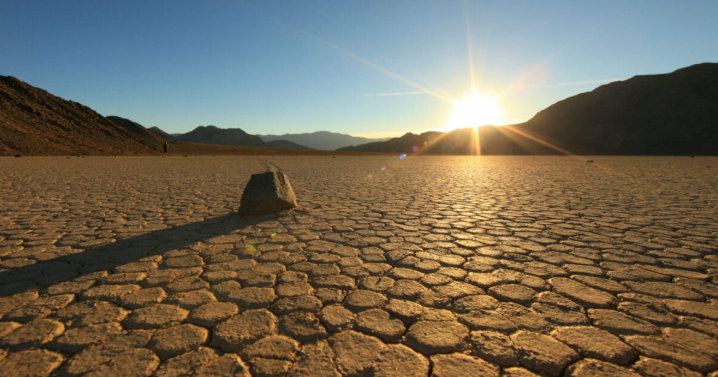

Today, we are visiting one of America’s great national parks. It is a place of strange and silent beauty. Although this place is beautiful, its name suggests that there is a very real danger here. Join us as we explore Death Valley.
It is a land of beautiful yet dangerous extremes. There are mountains that rise more than three thousand metres into the sky. There is a place called Badwater, which is the lowest point in the Western Hemisphere. If there were water there, it would be 86 metres below sea level.
Death Valley can be dangerously cold during the winter months. Storms in the mountains can cause sudden flooding in the valley below.
Summer temperatures can reach as high as 57°C. The sun can heat the ground to a temperature as high as 74°C.
Death Valley’s extreme heat has killed people in the past. It will continue to claim lives if people do not respect this extreme climate. Death Valley does not forgive carelessness.
It is a prime example of the violent nature of the environment. It contains evidence of several ancient volcanic explosions.
One of these explosions is known as Ubehebe Crater. The explosion left a crater almost a kilometre and a half wide.
In many areas of Death Valley, it is easy to see where the ground has been violently pushed up by movement deep within the Earth. This movement has created unusual and beautiful rock formations. Some are red. Others are dark brown, grey, yellow or black.
In other places, the rock looks as if a huge creature had broken and twisted the Earth to create unusual and sometimes frightening shapes.
In other parts of Death Valley, lines in the rock clearly show that this area was submerged under an ocean for many thousands of years. Much of the valley is flat and extremely dry. In fact, scientists believe that it is the driest place in the United States. In some areas, the ground is pure salt. Nothing grows in this salty soil.
However, it would be wrong to think that Death Valley is devoid of life. The valley teems with life. Wildflowers grow quickly after a little rain. Some desert plants can send their roots down by more than eighteen metres to reach water deep underground.
Many species of bird live in Death Valley. So do mammals and reptiles. You might see coyotes, which are small dog-like animals, or bighorn sheep. Other animals include desert jackrabbits, desert tortoises and a large reptile called a chuckwalla. The Valley is home to many kinds of snakes, including the sidewinder rattlesnake. This extremely poisonous snake has long, sharp teeth called fangs.
Death Valley is a huge place. Spanning more than two hundred and twenty-five kilometres, it extends across the southern part of California and into Nevada. It is part of the Mojave Desert.
The area was named by a woman in 1849. This was the year after gold was discovered in California. Thousands of people from other parts of the country travelled to the gold-mining areas in California. They were in a hurry to get there before anyone else did.
Many people were not careful. They made bad choices or wrong decisions. One group trying to reach California decided to take the Old Spanish Trail. By December, they had reached Death Valley. Although they did not have to endure the intense summer heat, there was still an extreme lack of water. There were also few plants for their work animals to eat.
The people could not find a way through the tall mountains to the west of the valley. Gradually, they started to run out of food. In order to survive, they killed their working animals for food and started walking out of the valley. As they left, one woman looked back and said, ‘Goodbye, Death Valley.’ The name has never been changed.
Almost everyone who visits Death Valley goes to see a huge house called Scotty’s Castle. Designed in a Spanish style, the building has high, thick walls to provide protection from the fierce heat. The main building is enormous. It was built in 1929 in one of the few areas of the valley with water.
The castle is named after Walter Scott, who was known as ‘Scotty’ by his friends. He was a gold miner. He claimed that he had built the house with money he had made from his gold mine. Many people believed him. But that was not the truth. Scotty was not an honest man. Several years earlier, he had asked several people to invest in a gold mine he owned in Death Valley. Among those he approached was a businessman from Chicago named Albert Johnson.
Mr Johnson invested in Scotty’s mine. In 1905, he travelled to Death Valley to see it. Scotty put Mr Johnson on a horse and rode with him deep into the mountains. Many people believe that, during this trip, Scotty revealed to Mr Johnson that there was no mine. There was no gold.
Albert Johnson was in extremely poor health. He had been in a severe accident a few years earlier. Doctors did not think he would live much longer. However, something happened on his trip with Scotty. When he returned from the mountains, he felt better than he had in years. Maybe it was the clean mountain air that made him feel better. Or maybe it was the good food Scotty cooked. Or maybe it was the funny stories Scotty told that improved Mr Johnson’s health.
Albert Johnson fell in love with Death Valley, whatever it was. He and Scotty became lifelong friends. Soon after, he began building a home on the western edge of the valley. He didn’t live there all the time, though. But Scotty did. He told everyone that the huge house was his — bought and paid for with money from his gold mine. He told people that his friend Albert Johnson from Chicago sometimes came to visit. Mr Johnson never revealed that it was just a story made up by Death Valley Scotty.
Albert Johnson lived for another thirty years — much longer than the doctors thought he would. A few years before he died in 1948, Albert Johnson signed documents allowing Walter Scott to live in the house until his death. Scotty died in 1954. He is buried on a small hill near the house.
In 1970, the National Park Service bought Scotty’s Castle. It has since become one of the most popular attractions in Death Valley National Park.
More than one million people visit Death Valley each year. Many of these visitors only stay for a day. Buses bring visitors from the famous city of Las Vegas in the neighbouring state of Nevada. They ride around the park on the bus, visit several places, and return to their Las Vegas hotel in the evening. However, many other visitors choose to stay in the park. The most popular area is Furnace Creek.
This is the largest area of human activity within the park. There is a hotel. There are also camping areas where people put up tents. Visitors arriving in large motor homes can also find parking.
The famous Furnace Creek Inn is a beautiful stone hotel built more than seventy-five years ago. It is built on a low hill. The hotel’s main public room has large windows offering far-reaching views of Death Valley. In the evening, hotel guests gather near these windows to watch the sun casting long shadows across the valley floor and the distant mountains.
This beautiful scene seems to change every minute. The sun slowly turns the valley gold, the colour deepening to soft brown before changing to dark red. As night falls, the mountains turn first purple and then black.
Visitors are usually very quiet when this event takes place. A few try to photograph it. However, the valley is too vast to capture in a photograph. Most visitors simply enjoy the natural beauty of the sunset at beautiful Death Valley National Park and leave with only the memory of it.