

You might see two cowboy boots at the Smithsonian American Art Museum in Washington, D.C. They are adorned with a cloud and star design.
They look like boots that you could wear. But they are actually made of carefully formed clay. These ceramic pieces were made by the artist William Wilhelmi. How did he create these colourful boots? Today, we explore the world of clay art and answer that question.
Clay is one of the most universal materials known to humans. Throughout history and around the world, people have used it to make ceramic objects, or pottery. Clay is made of water and earth. It can be formed into different shapes. High levels of heat then harden it to produce many kinds of ceramics.
The minerals in clay, such as silicon or iron dioxide, determine its properties. The minerals in clay affect how easy it is to work with. The mineral content of clay also affects the temperature at which it hardens.
Earthenware is one of the earliest types of clay used by humans. It hardens at a lower temperature than another type of clay called stoneware. Porcelain is another type of clay.
It is very fine and smooth. All of these clays need to be fired at high temperatures. Early pottery was heated in the sun or over a fire. Later, potters developed devices called kilns to control the firing process.
The development of ceramics has had a significant impact on human history. Ceramic objects enabled early cultures to create containers for holding water. This meant that they could cook foods such as vegetables and meat. Improving food production methods enabled larger populations to survive. Pottery is an art form that emerged from everyday life.
Ceramics are also important to historians and archaeologists. Pieces of pottery found in archaeological sites can reveal information about ancient cultures. These artefacts can survive for tens of thousands of years. They provide answers to questions about cultures about which we know little.
There are many different ways to shape clay. The earliest method involved shaping it by hand. Containers were formed by pressing a ball of clay into a given shape.
Alternatively, they place long, thin rolls of clay on top of each other and make them smooth. Another method is called slab construction. A ceramist creates several flat pieces of clay that can be joined together to form the sides of a container.
Later, potters developed the method of ‘throwing’ clay on a wheel. A ball of clay is placed on a wheel that turns quickly. The potter holds the clay firmly and guides it as the wheel and clay turn. By applying different amounts of upward pressure, the potter can build up the sides of a container. This method enables potters to produce similar pieces quickly. However, it takes a great deal of skill to become an expert at wheel-throwing.
Another method is slip casting. A ceramist pours liquid clay into a hard mould or form. As the clay dries, it takes the shape of the mould. This method is useful for making highly detailed objects. It is also useful because the mould can be used repeatedly to make exact copies of the ceramic form.
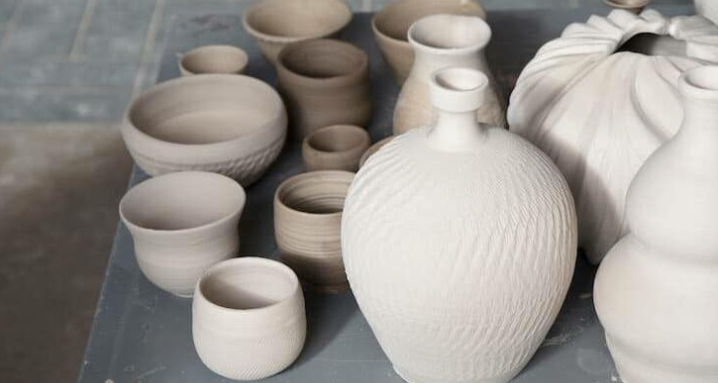
There are also many ways to decorate ceramics. One simple method is to scratch designs and images into the clay. Alternatively, they can be more complex, such as using liquid glazes to alter the colour or shine of the clay surface.
Pottery is an important example of cultural exchange. For instance, the traditional Mexican pottery style underwent significant changes in the fifteenth century. Following the arrival of Spanish settlers, Mexican potters stopped making their own religious figures. Instead, they started making Christian religious forms. The Spanish also introduced materials and methods used in Europe, including the potter’s wheel.
Trade exchanges spread ceramics all over the world. As early as the tenth century, the Chinese were trading their ceramics throughout the Middle East and Southeast Asia. Chinese ceramics later had a significant impact on European ceramics. As early as the eighteenth century, Europeans started to copy the fine traditions of Japanese and Chinese ceramics.
Ceramics demonstrate the depth of human creativity. This art form reflects the local needs and materials of a community. Pottery can differ greatly from one country to another. However, it can also differ greatly within areas of the same country. For instance, in Mexico, each region has its own unique clay tradition. In one part of Oaxaca state, potters have been making black clay containers in the same way for centuries.
In another part of the same state, shiny green-coated pots for cooking are made. Nearby, artists create female figurines from orange clay.
In the Mexican state of Michoacán, meanwhile, potters make white clay containers adorned with line drawings of fish and other animals. In another part of the state, artists make green, painted containers shaped like pineapples.
In the State of Mexico, artists make clay candle holders adorned with clay animals, plants and people. These are painted in bright colours. These are just a few examples of Mexican ceramics.
Imagine how many different clay traditions exist in other parts of the world. What kinds of ceramics are made where you live?
W Studio is located on a quiet street in Corpus Christi, Texas, United States. This is where the potter William Wilhelmi creates his art. Let’s go back to the ceramic cowboy boots we mentioned earlier. Listen to Wilhelmi explain why he chose to make these boots from porcelain:
William Wilhelmi: ‘I’m William Wilhelmi, and I made the porcelain cowboy boots at the Smithsonian in Washington, D.C. They are the only pair of porcelain boots. We use a low-temperature-fired clay here, which is very easy to work with. The reason the ones at the Smithsonian are porcelain is that they were having a show called ‘American Porcelain’. They asked me if I would enter a pair of boots into the exhibition. They asked, ‘Are they made of porcelain?’ I said, “Why, sure!”
William Wilhelmi made these boots using the slip casting method. He took two real cowboy boots and made a hard mould using their shape. Then he poured liquid clay into the moulds. Once the boot forms had dried, he added clay details to represent the leather material of the shoes. Later, he painted a Texas night sky on the sides of the boots. He also made the points of the boots shiny gold.
Wilhelmi is also known for his clay ‘monster’ creatures. He adds these friendly little creatures to many of his ceramic pieces. He says they add humour and a sense of activity. Another design that Wilhelmi likes to use is the eucalyptus tree. He paints these trees in black on many of his clay dishes, bowls and cups.
Being a potter can be difficult, says William Wilhelmi. There is no guarantee that a clay object will survive being fired at high temperatures. You can spend a great deal of time making an object, only for it to break in the kiln. However, he says that working with clay is also very pleasant. It allows him to express his sense of design, colour, and shape in many ways.
The work of William Wilhelmi can be found in museums all over the United States. His work is collected by many important people. For example, Hugo Chávez, the former president of Venezuela, owns a pair of his clay boots. So does Vicente Fox, the former president of Mexico. To see a large collection of the artist’s work, visit the Wilhelmi/Holland Gallery next to W Studio. Here, you can buy Wilhelmi’s work, as well as pieces by other artists.
Alternatively, visitors can watch Wilhelmi at work in his studio. This large room is filled with interesting objects such as photographs, artwork and books. There are also many worktables covered with tools, colour glazes, and clay forms. In one corner of the room, there are three kilns and a potter’s wheel.
William Wilhelmi finds inspiration for his art by travelling and reading books. He talks about how clay art is both universal and personal.
William Wilhelmi says, “The thing about clay is that every culture knows it because they use it. That is one of the advantages of working with clay. Everyone can relate to clay. It’s been part of our human evolution. It ranges from the most basic to the most elaborate things. As one lives one’s life, one takes in all one’s experiences. Then, when I sit down to work, these experiences come out in my work. Your work reflects the experiences of life.”