
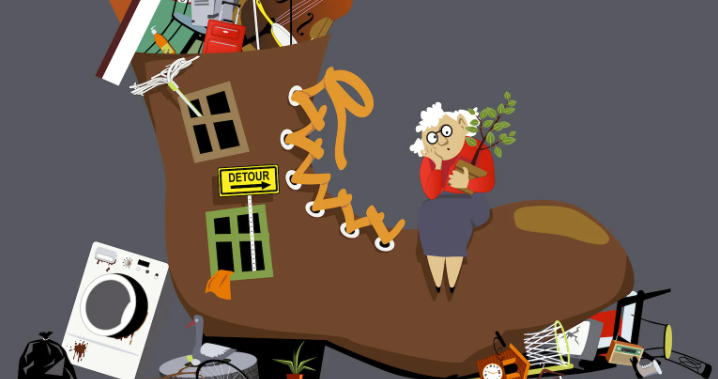

Today, we talk about compulsive hoarding syndrome. It is both a mental illness and a public safety issue.
Many people in the United States are looking forward to spring returning. During this season, millions of Americans do what is known as ‘spring cleaning’. They open their windows to let in fresh air. They use cleaning products to make their homes smell nice. Some also organise their belongings.
Many Americans have a strong desire to tidy up their homes. This can also be called decluttering. Clutter is a disorganised collection of things. Removing clutter means throwing away the things you do not want. Then, you organise the things you have decided to keep.
In recent years, it has become easy to find information on how to tackle clutter. There are books, websites, and TV programmes on the subject. Speciality stores sell storage containers and boxes.
Some Americans even pay people to come to their homes and remove their clutter. These people provide advice on what to keep and what to throw away. They also help with organising things. However, professional organisers can be expensive. Such services can cost up to two hundred dollars an hour.
Some people have serious problems with clutter. They have a mental disorder called compulsive hoarding syndrome. It is estimated that this disorder affects one million people in the United States.
It is commonly connected to obsessive-compulsive disorder (OCD). This disorder causes people to have thoughts that interfere with their daily lives. Those affected act on these ideas, even when they know the resulting actions are unreasonable.
A fear of dirt may cause people with OCD to repeatedly wash their hands. They may also repeatedly check that all electrical devices are turned off.
Without treatment, people with OCD may not be able to control the urge to perform these senseless activities. Those with compulsive hoarding syndrome gather many objects and are unable to part with them.
Most people would say that the things hoarders collect are useless or worthless. However, hoarders believe that these items could be useful one day. They may even develop an emotional connection to these items.
Hoarders are afraid to throw things away. At the same time, they continue to bring more and more items into their homes. They may save items such as newspapers, clothing and even old food.
Hoarders live with so much clutter that it can pose a risk to their physical health. Dirt, insects, and bacteria that build up over time can cause illness.
Safety experts say that hoarders’ homes are often unsafe. For example, a room filled with newspapers can cause floor supports to break down. Often, a room is filled from top to bottom with useless items. There is only a small walking space from one end of the room to the other.
One of the most famous hoarding cases involved two brothers in New York City. Homer and Langley Collyer were found dead in their home in 1947.
Langley Collyer was buried under what appeared to be a mountain of old newspapers. The weight of the newspapers had crushed him. Langley had been Homer’s carer. Medical experts believed that Langley had been dead for several days before his brother, Homer, died of starvation.
The police found the house filled with thousands of unread books, pieces of wood and the skins of large fruits and vegetables. The brothers had also saved pipes and very large automobile parts.
Compulsive hoarding can severely affect a family. Family members who share a home with a hoarder often find it hard to understand why their loved one keeps so many useless — and sometimes dangerous — things. This prevents the family from enjoying their home. Experts say that the hoarder should make a greater effort to keep the home clean and organised. However, this is not that simple.
Randy Frost is a psychologist at Smith College in Massachusetts, USA. He has studied hoarding. Professor Frost says that hoarding is more than just a mental disorder. He says it is a public health problem.
Severe health risks can result from collecting waste, food or flammable materials. In the United States, hoarding violates laws created to protect public safety and property. Some cities have formed groups to address the issues arising from hoarding. Each group usually has representatives from one or more government agencies.
Officials from these agencies say they often hear about hoarders from people who live near someone affected by the disorder. These individuals are tired of seeing broken household items and old clothing strewn across the land near their homes.
Those suffering from compulsive hoarding disorder do not only collect objects. Some also collect cats, dogs, birds, snakes and other animals.
Most animal hoarders believe they are rescuing animals in order to care for them. However, they do not realise when they have too many animals. In fact, they are doing more harm than good. They may not be able to provide healthcare for the animals. Some animals may go without being washed or fed.
Officials have been shocked by the state of animal hoarders’ homes. The floors were covered in animal waste. Infectious diseases were rife. Some animals were found starving, while others had died.
A grand jury in New York recently charged a man and his wife with hoarding one hundred cats. The cats had clearly not received proper care. Investigators said that some of the animals were missing teeth or eyes.
Others were suffering from insect bites and dehydration. The owners were charged with torturing and injuring animals.
The American public has shown a keen interest in the strange behaviour of animal hoarders, such as the couple in New York. Several television channels show reality programmes about hoarders. These programmes present events as they happen, such as the rescue of animals from hoarders’ homes.
Television cameras capture the sadness of the owners as animal control officers remove their pets. They also show the struggles of the hoarders and the efforts of people who want to help them.
Gregory Chasson is a mental health expert and professor at Towson University in Maryland. He says that the public’s interest in hoarding programmes stems from the natural human desire to collect things.
For most people, this simply means behaviour such as keeping too many papers or having a little clutter. However, he adds that hoarding becomes a mental health problem when it interferes with normal life.
Professor Chasson says that compulsive hoarding is extremely difficult to treat. He says that hoarders are less likely than others to recognise that they have a problem. However, he suggests that cognitive behavioural therapy can help.
In this method, hoarders work with an expert to understand why they gather and save so many things.
Once the reasons for the hoarding have been identified, people can develop an organisation plan. They can learn how to decide what to throw away. They can also learn to resist the urge to bring home more items.
Some hoarders find it helpful to meet with others and talk about their struggles. These group therapy sessions can be held in the hoarders’ homes. However, therapy does not always take place in person.
Some meetings for hoarders are held online. Some hoarders also use their computers to communicate with a supportive person.
Taking a picture of an area before and after it has been organised can give hoarders a sense of progress. With improved decision-making skills and ways of thinking, it is possible for a hoarder to stop hoarding.