
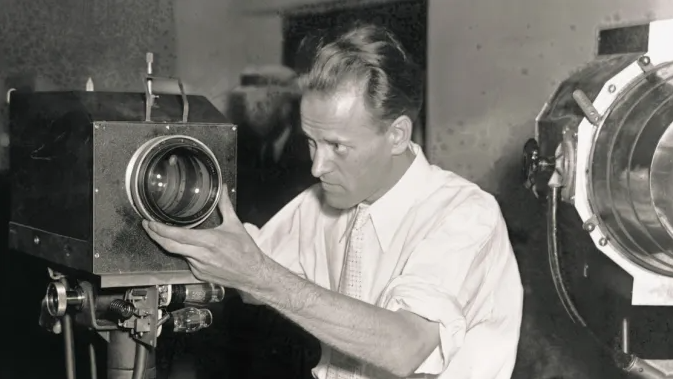

The electronic television is arguably the most significant communication and entertainment medium of the 20th century, shaping global culture, news, and history. While many scientists and inventors contributed to the development of television, Philo Taylor Farnsworth, an American inventor, holds the credit for designing the first fully functional, all-electronic television system. His innovative concepts replaced mechanical systems and established the technical foundation for modern digital displays.
Early Life and the Inspiration in the Fields
Philo Taylor Farnsworth was born in 1906 in a log cabin in Beaver, Utah. From his early childhood, he showed a profound fascination with mechanical and electrical devices, converting his family’s manual washing machine into an electric one. The inspiration for his most famous invention came in 1921 when he was only 14 years old. While plowing a potato field on his family’s farm in Idaho, he looked back at the parallel rows of turned soil. It occurred to him that an electronic picture could be projected onto a screen in the same way: by scanning an image line by line using a beam of electrons.
The Battle Between Mechanical and Electronic Television
In the 1920s, other inventors, such as John Logie Baird in Scotland and Charles Francis Jenkins in the United States, were experimenting with television. However, their designs relied on mechanical systems that used spinning metal discs to capture and project images. These mechanical televisions produced low-resolution, flickering pictures and were limited in speed. Farnsworth recognized that mechanical parts could never move fast enough to produce high-quality moving images. He realized that only a system using electricity and light beams could achieve the speed and resolution needed for practical television.
The Invention of the Image Dissector
In 1926, Farnsworth secured financial backing and established a laboratory in San Francisco. On September 7, 1927, at the age of 21, he successfully demonstrated his invention: the Image Dissector. This was the first all-electronic television camera tube. It captured light from an image, converted the light into electrical signals, and transmitted those signals to a receiver tube, which reconstructed the image line by line on a screen. The first image transmitted was a simple horizontal line, followed by a dollar sign to satisfy his investors.
The Patent Wars with RCA
Farnsworth’s success caught the attention of the Radio Corporation of America (RCA), which dominated the radio industry and wanted to control the future of television. RCA’s chief engineer, Vladimir Zworykin, had been working on a similar electronic television system. RCA refused to pay royalties to Farnsworth, leading to a long and expensive patent lawsuit. In 1939, the courts ruled in Farnsworth’s favor, declaring him the original inventor of electronic television and forcing RCA to pay him millions in licensing fees. Despite his victory, World War II delayed television broadcasting, and by the time TV became popular, Farnsworth’s patents had expired, leaving him largely forgotten by the public.
Key Milestones in Farnsworth’s TV Development
- 1921: Conceives the idea of electronic scanning while plowing fields.
- 1927: Successfully transmits the first electronic image in his laboratory.
- 1939: Wins the historic patent battle against RCA, forcing royalty licensing.
Frequently Asked Questions
Who is Philo Taylor Farnsworth?
Philo Taylor Farnsworth was an American inventor who designed the first fully functional, all-electronic television system, replacing early mechanical disc designs.
What was the Image Dissector?
The Image Dissector was Farnsworth’s camera tube that captured light and translated it into electrical signals, allowing images to be transmitted electronically.
How did plowing fields inspire the invention of television?
Plowing fields in parallel lines made Farnsworth realize that a camera could scan a visual scene line by line using an electron beam to capture and project images.
Why did Farnsworth fight a patent lawsuit against RCA?
RCA wanted to control the television market and claimed their engineer invented the system. The court ruled for Farnsworth because his high school drawings proved his prior invention.
Why is John Logie Baird also associated with television?
John Logie Baird invented the first mechanical television. However, his mechanical design was replaced by Farnsworth’s superior electronic scanning system.
Did Farnsworth become wealthy from his invention?
Although RCA paid him royalties, the outbreak of WWII delayed TV commercialization. By the time TV took off in the late 1940s, his patents had expired, limiting his wealth.
What other inventions did Farnsworth develop?
Farnsworth held over 300 patents, contributing to early versions of radar, the electron microscope, incubator systems, and a small nuclear fusion device called the Fusor.
When was the first electronic television transmission?
The first successful electronic television transmission occurred on September 7, 1927, in Farnsworth’s laboratory in San Francisco, California.
Conclusion
Philo Taylor Farnsworth was a brilliant inventor whose concept of electronic scanning shaped modern media. His work laid the foundation for the visual communication systems, computer monitors, and digital displays we rely on today.