

During the winter season, major news outlets often warn of severe, bone-chilling cold waves sweeping across North America, Europe, and Asia. In recent years, meteorologists have frequently blamed a meteorological phenomenon known as the polar vortex for these extreme weather events. While it sounds like a modern climate change buzzword, the polar vortex is a well-established atmospheric feature that plays a critical role in Earth’s weather patterns, and understanding its dynamics helps explain winter storms.
What is the Polar Vortex?
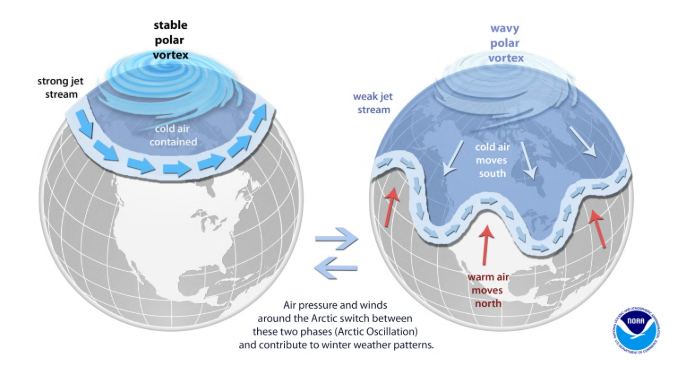
The polar vortex is a large, persistent, low-pressure area of freezing, swirling air located in the upper atmosphere (stratosphere) near Earth’s poles. There are two polar vortices on Earth: one over the North Pole and one over the South Pole. The vortex is strongest during winter when the temperature difference between the equator and the poles is at its peak. The freezing air within the vortex rotates counterclockwise (in the Northern Hemisphere) and is held in place by a fast-flowing band of westerly winds known as the jet stream.
The Role of the Jet Stream
The jet stream acts as a thermal barrier, trapping the freezing Arctic air in the polar region and keeping warmer air to the south. When the polar vortex is stable and strong, the jet stream flows in a relatively straight line around the pole, keeping the freezing air locked away. However, when the polar vortex weakens, the jet stream slows down, loses its shape, and begins to wave and bend. These bends allow cold Arctic air to spill southward, while warm air is pushed northward.
Sudden Stratospheric Warming: The Disruption Trigger
The main trigger for a polar vortex disruption is a phenomenon called Sudden Stratospheric Warming (SSW). This occurs when large-scale atmospheric waves travel upward from the lower atmosphere into the stratosphere, causing temperatures in the polar stratosphere to spike by up to 50°C (90°F) in a few days. This sudden warming disrupts the circulation of the polar vortex, causing it to weaken, shift off the pole, or split into multiple smaller vortices that migrate southward, bringing extreme winter storms to mid-latitudes.
The Connection to Global Climate Change
Climate scientists are actively researching whether global warming is making polar vortex disruptions more frequent or severe. As the Arctic warms twice as fast as the rest of the planet—a process known as Arctic amplification—the temperature difference between the pole and the equator is shrinking. Some scientific models suggest this reduced temperature gradient weakens the jet stream, making it wavy and prone to splitting, which leads to prolonged cold snaps in places like the United States and Europe.
Key Characteristics of Polar Vortex Systems
- Atmospheric Level: Located in the stratosphere, about 10 to 50 kilometers high.
- Seasonal Strength: Strengthens in winter due to lack of sunlight, weakens in summer.
- Disruption Effects: Triggers extreme snowstorms, freezing rain, and record-low temperatures.
Frequently Asked Questions
What is the polar vortex?
The polar vortex is a large area of low pressure and freezing, rotating air located in the stratosphere above Earth’s poles.
Does the polar vortex cause global warming?
No, the polar vortex is a natural atmospheric system. However, global warming may be altering its stability, causing cold Arctic air to spill southward more frequently.
What is the jet stream’s role in the polar vortex?
The jet stream is a band of strong wind that surrounds the polar vortex, acting as a barrier that keeps freezing Arctic air trapped at the poles.
What happens when the polar vortex disrupts?
When the vortex is disrupted, the jet stream bends, allowing cold Arctic air to move south into regions like North America and Europe, causing extreme cold waves.
Is the polar vortex a new scientific discovery?
No, the polar vortex is not new. Meteorologists have known about and studied the polar vortex since the mid-19th century, although public awareness has increased recently.
What is Sudden Stratospheric Warming?
Sudden Stratospheric Warming is a rapid temperature rise in the polar stratosphere caused by atmospheric waves, which destabilizes and splits the polar vortex.
How long do polar vortex cold snaps last?
Once the polar vortex is disrupted and cold air spills south, the resulting winter weather patterns and freezing temperatures can last for several weeks.
How can people prepare for a polar vortex event?
People can prepare by winterizing their homes, protecting water pipes from freezing, storing emergency food and water, and limiting outdoor exposure during extreme wind chills.
Conclusion
The polar vortex is a natural and critical part of Earth’s complex weather systems. Understanding its behavior and its interaction with the jet stream allows meteorologists to forecast extreme winter cold waves and protect public safety.